In a previous post we looked at jing/essence as a trust fund of inherited constitutional energy, intended to be used for procreation and emergencies only, but regularly wasted through failure to understand that:
a) it is not infinite, and
b) it can only be replaced through long-term quiet accumulation in the midst of stillness.
Jing/essence is, in fact, the power of our youth. Those with less age quickly.
Chen Zhi-Xiu (Shang Yang-Zi) quotes the Daoist acupuncturist Ma Dan-Yang about its importance:
The most precious thing people have is jing/essence, but it is very limited … [Ma] Dan-Yang says ‘Sex is worse than tigers or wolves, it destroys a person’s beauty and bearing, it ruins good actions. Wasted jing, extinguished spirit — these simply lead to premature death. Those who would aspire to the Dao must avoid [excess in this regard].’*
Chen goes on to say:
Others, of less intelligence, quip that the span of their life is set by fate, why not enjoy it? But the old saying warns: when the oil dries up, the lamp goes out; when the marrow is exhausted, a person dies. You must know that jing/essence is the root and basis of your body — how long does a tree last when its root is cut away?’ To nourish life, first treasure the jing/essence. When the jing/essence is full, qi will flourish, and then the spirit will be hearty, the body healthy, with few illnesses. The organs inside will function perfectly, the skin outside will glow, your visage will be bright, your eyes and ears and brain sharp! And all of this from reducing the wastage of jing/essence in your youth. If you have done this, and on top of this can reduce desire altogether, you will live a good long life.
It is not only ejaculation that wastes jing/essence: anything that disturbs its quiet repose and incites it to movement has already caused wastage of the jing, as it has become transformed into active energy waiting to be used. Jing is potential. Once this source has been tapped, that activated energy cannot be easily transformed back into the potential which was.
So what disturbs jing? Anything that excites desire, especially sexual desire, disturbs jing. Little desires cause little disturbance, the greater the desire, the greater the disturbance to the jing/essence. Desires modified by control are much less disrupting.
This whole concept, of course, is anathema to a consumer-driven society (or at least to the information media fueled by advertising), which is why these sorts of ideas are not very popular, but we should be able to see that in fact unbridled craving for things is ultimately weakening for the whole society: less essence, less spirit, less will.
This idea, that desire which is not skillfully controlled will easily drain jing/essence, also shows up the potential danger in the “Taoist sexual techniques” advocated by so many popular books — dangers in fact warned against for centuries by Daoists themselves. Thomas Cleary’s Sex, Health and Long Life provides a balanced introduction to the topic.
And how do we build up jing/essence, then? Well, how about a little peace and quiet, first …
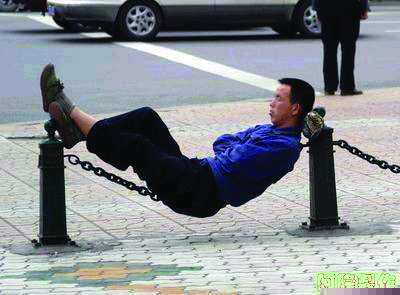
Xiaoyao building up his jing/essence …
* 盖色之害人,甚于狼虎,败人美行,损人善事,亡精灭神,至于损躯,故为道人之大孽。

 The Fat Monk
Yesterday I read the following: “…. there is no end to man’s capacity to devour, without being in any way changed.” I have the feeling that this is very similar. Without knowing where our energy comes from and how to preserve it, the knowledge of “refilling” in retrospect is like filling a jar without a base. I personally think that information like that which is written here is necessary and helpful. Everything else we can read somewhere else.
Yes, the Afanti stories have a way of presenting a pattern of behaviour in a very memorable way. Here is another one:
It was rumoured that Afanti had a bottle of precious 40 year old vinegar. A distant relative presented himself at Afanti’s house and said “I’ve heard about your 40 year old vinegar. How about giving me a taste?”
Afanti said “Well, it would not have lasted 40 years if I kept giving it away to everyone, now, would it?”