少小離家老大回,
鄉音無改鬢毛衰。
兒童相見不相識,
笑問客從何處來。
Young, so young, when I left home
Now, so old, I return.
The lilt in their language
Has not changed;
It’s my beard that’s gone grey.
A man I knew when a child
Now smiles, and says :
‘Where are you from,
Stranger?’
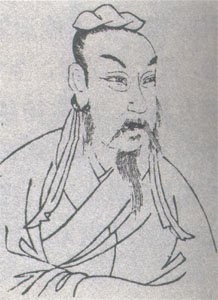
The poet who wrote this, He Zhi-Zhang, lived from 659 to 744 in Zhejiang province. He was already famous in his youth for his poems and his big-hearted, broad-minded manner. He drank, joked and disputed with poets of the calibre of Li Bai and Du Fu.
He Zhi-Zhang’s easy-going manner while inebriated was portrayed in Du Fu’s poem entitled Song of the Eight Immortals at Drink.
He Zhi-Zhang was a Taoist and later disappeared into the countryside.

 The Fat Monk
Thank you Xiaoyao for this fantastic translation!
This poem by He Zhi-Zhang is one of my favourites, and whilst I’m still very new to the amazingly vivid and rich world of Tang poetry and can’t comment much on the depth and subtlety of the poems, I feel like you captured the rhythm of the original really well in the translation.
Yes, this was also the first poem I learned to “sing” in the classical style.
For a really good idea of the depth of a Chinese poem, as well as the hazards of translating it, see this post, where Stephen Owen goes into the background of one of his translations of a beautiful poem from Wang Wei.
https://harvardmagazine.com/1998/07/norton.sidebar.html
this is wrong, dude.
乡音无改 refers to the local dialect spoken by the poet, in contrast to his gray beard (any baidu search turns this up.) similarly, it’s not a childhood acquaintance, but an actual child, that the poet encounters (look at the many illustrations of the poem; you’ll see they’re all of an older man being greeted by a child). the 相见 here is not the “mutual” in modern Chinese, but a 语气词 (it means nothing).
chinese translator here, just passing through.