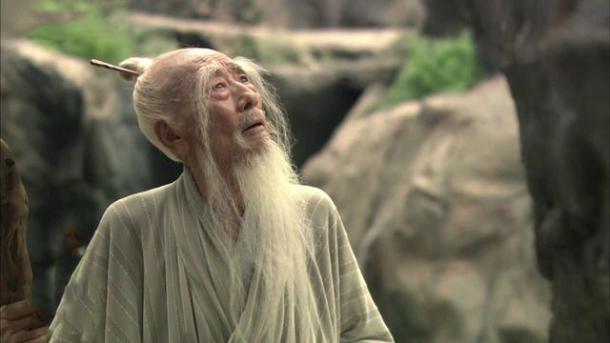
Bai Yu-Chan from Hainan travelled through Sanshan in Fujian and stayed at the Daoist Zi Xu’s residence. Péng Sì (彭耜), whose style-name was Hè-Lin (鹤林), passed by and asked about the crucial aspects of method in the Dao.
Question:
When I investigate directions for the great medicine of the golden elixir, there are many terms such as Sun and Moon, Dragon and Tiger, Lead and Mercury, Kan and Li, Firing Method, Cosmic Orbit, and also trigram and hexagram symbols, and even further terms like “the supine moon” and “the cauldron of cinnabar sand.” Not only are there multiple terms, there are all sorts of activities. Is it just that there are many names for one thing? Or do each of the many terms specify something different? If we look inside, it is formless; seeking outside there are images, and so is the trick in doing? or is the trick in stillness? The ancients said that that which involves doing is not the Dao, but they also said that if one is addicted to stillness this is only sitting in oblivion like a withered tree.
I am confused and don’t know how one should enter the path which leads to the innermost recesses, and thus respectfully request an explanation.
Answer:
The first sages looked up to observe celestial phenomena, they looked down to observe the principles of the earth. They observed that which is close by looking within their own bodies, while the distant they discovered in external things. Their creation of alchemical sayings had the intention of establishing long life without death, to clarify people’s minds; actually it is a unified principle.
The beginning entrance is in yin-yang and the five elements, the final arrival returns to unlimited formlessness (hùndùn wújí 混沌無機).
The alchemical methods you mentioned each has their basis, yet each sets up an explanation and holds to a particular view, and thus it is hard to bring all of them into unanimity. The important thing is who I meet, what is transmitted to me, the fruits of that transmission and what I do with it all.
[The symbols vary widely: for example, if we use terms centered] in heaven it is sun, moon, stars and constellations; in earth it is birds, beasts, grass and trees; in people it is husband, wife, son and daughter. If we use the Yi Jing (Book of Changes) names of trigrams to discuss the matter, then it will be Qian, Kun, Kan and Li; if we use wu xing (five phases) to discuss the matter, it is metal, wood, water and fire; if we talk in terms of medicinal substances, it will be silver, lead, cinnabar and mercury. If we use the terms of the search for immortality (dān dào) then it will be dragon, tiger, crow and rabbit.
In its utilisation there are the names platform, oven, cauldron and stove; in its practice there are the images of rising, falling and mating together; in its embodiment there are the changes felt as floating, sinking, clear and turbid; as you follow it there are the signs experienced as yin, yang, winter and summer.
The sages thus said: gather using medicinal substances, refine using the firing process, congeal it to form the Cinnabar Pill, and you transcend the ordinary and become a human sage.
Therefore [regarding your question about looking inside or outside] when you obtain it internally, you do not become mired in internal images, when you obtain it externally, you do not look for it only in external objects. This is the meaning of “neither object, nor image”.

 The Fat Monk