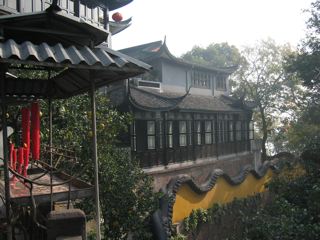
There was no sign, early that foggy morning, of the noisy crowds that later would mill around the base of the mountain and swarm toward the temple up the road, the one with the massive golden Buddha, exotic rock carvings and lines of knick-knack stalls lining the road to its gate.
Though it was the same mountain, I took another path. Entering a smaller stone archway almost hidden here in the undergrowth, its keystone marked with the characters Embrace Simplicity, the way led off through a tunnel of trees before beginning its ascent up the steep slope.
My goal was a small Daoist Guan, boarded up and abandoned due to political oppression at the time I had first stumbled across it, many years before, but hopefully now restored. Working my way through boulders and groves of green thick-waisted bamboo, the worn stone steps gradually narrowed as the leaf-strewn path climbed higher. In the pre-dawn quiet, the fog gathered slowly until there was only the path, the boulders, the bamboo and my feet. Then the sun rose, and the gently descending mist around me shone with a golden efflorescence before gradually dissipating in the warm rays.
I was seeking an ancient text long out of print, Liu Yi-Ming’s Dao Shu Shi Er Zhong, for which I had been searching for years in the dusty bookshops and backstreets of Shanghai and Hong Kong. A smaller Daoist monastery might well possess a copy unavailable elsewhere, and they often supplemented their income with the sale of Daoist books. But was this monastery even inhabited?
Sweating in the cool mist which gently echoed my foot-falls, I became aware of a subtle waft of fragrance. Incense! My spirits lifted. The path led around a deep rock pool with goldfish fed by a small waterfall, and there were the gates.
An undulating wall resembling the back of a dragon was topped with black tiles, and arched upward over the opening. The heavy wooden gates each held a large brass knocker in the shape of a beast with fierce staring eyes and a broad nose. I had just lifted the knocker when the other door of the gate swung back a fraction, exposing two eyes that peered out at about the level of my chest, then lifted to my face. “Shifu hao!” I greeted the doorman. “Forgive my disturbing you, but …” I enquired about their library, and whether it might be possible to visit. He stepped back, wordlessly, but as I came through the gateway he gestured toward some wooden steps at the rear of the wide courtyard.
The courtyard was dusty, and in the middle a large black cauldron smoked. It was a ting, a cauldron with three legs; writhing dragons stood out on its sides, and the clouds of incense seemed to issue from them. Legend said this area of the mountain was the original laboratory site for a reclusive alchemist in the Jin dynasty well over a thousand years before.
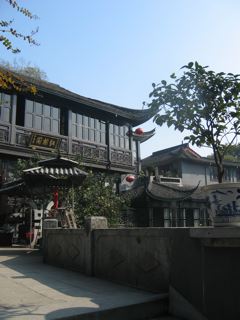
It took some wandering through the recesses of the labyrinthine wooden passageways before I found the library. It was resolutely closed with a beam lifted into brackets on the outside of the door. Yet as I turned away in some disappointment, I heard the thud-thud-thud of rushing feet approaching from the rear of the compound. “Wei! Shi Zhu! Did you want the library?”
The Daoist was ruddy-cheeked, rather corpulent, and smiling; he looked about thirty-five as he lightly lifted down the beam, pushed open the double doors and led the way into the dark and musty space. “Liu Yi-Ming you say? Good choice! Now let’s see …”
As he rummaged we talked. He had been ordained at Wu Dang monastery in Hubei, he told me proudly. “Do you know Taiji?” he asked. “I can teach you!” His enthusiasm was infectious. There, he said, the monastery was built directly on the precipitous ridges of the Tian Zu Peak. “Talk about dragons – the qi at that place was incredible. Built right on the high back of the dragon ridge.”
I asked him what spurred him to become a Daoist, and he laughed quietly, sobering down somewhat. He had no choice, he explained. Even as a kid he felt there was more to life than what everyone else seemed to find important. “It was an urge to know what life was for. Later I found that knowing intellectually was not enough, you have to embody that knowledge, to be it, to know where you have come from, and where you are going to. Daoism seemed to be a path that would help me do so.”
But why not a Buddhist, say? His answer surprised me.
Getting stuck on what a person or a teaching looks like, and either rejecting them or blindly attaching oneself to them, is a common problem. But its only one of many things that can stop you from learning more.
“That would have been just as good. You know its funny how people get hung up on the externals, when the heart of the matter is what is important. My teacher at Wu Dang said that. Lao Zi said it too, in the very first chapter of his Dao De Jing.” Incongruously, as I thought of people mistaking the container for the content, there popped into my head an image of tiny children ignoring their Christmas presents to play with the wrapping paper.
“Liu Yi-Ming himself constantly emphasized that Buddhism, Daoism and even Confucianism were all one stream. San Jiao wei Yi, ba! Hei, zhao dao le! Hey! Found it!”
He held up a dusty blue cloth-bound box with two bone clasps holding it together and, blowing off some of the dust, set it on the wooden library counter. As he lifted out the group of books, which were bound traditionally with silk stitch-binding on blue paper, he remarked: “My teacher at Wu Dang came from the far west of China, and only became a Daoist later in his life. He had studied other things before that. But he said that the very first thing people need to learn in this endeavour is to recognize the common pitfalls. Getting stuck on what a person or a teaching looks like, and either rejecting them or blindly attaching oneself to them, is a common problem. But its only one of many things that can stop you from learning more. He said it is crucial to learn how and where one can go wrong, because these things happen to everyone, again and again. It is such a pity when people get caught at a level so far below their capacity. If you learn to recognise what can trap you –the pitfalls in learning– you have a much better chance of getting far enough along to make a difference.”
I was confused. “Pitfalls of learning? But I thought you’d start with meditation or …”
“Pah! You’re just like all the rest,” he said, with a mock-ferocious look, then smiled. “Xing ming shuang xiu, ba! Equal development of essence and life! That’s why we do internal martial arts at Wu Dang, we learn to stretch and relax the outside, which helps us to stretch and relax the inside. Everybody can do this much. My teacher said the key is to relax that fierce need to be right all the time, and let go of most of the things you are so sure you already know! Tai Chi teaches that – say, why don’t you come up here at dawn, and we can practice together while you are here?”
I agreed happily, and he bustled around gathering implements to make tea. I tried to remember where Lao Zi had talked about appearances and externals, and finally asked.
“In the very first two lines of the first chapter – that’s how important it is. In fact, almost every chapter has something on a common beginner’s pitfall, and sometimes how to avoid it. The first chapter warns us not to confuse the label with the thing itself, and the limitations of craving. The second warns us that over-reliance on authorities means that you give up your own ability to perceive the truth. ‘Everyone knows beauty is beauty …’ but what if you disagree? Would you speak up? Or would you censor yourself before you even recognized the thought?”
He put a kettle onto an ancient looking feng lu, a three-legged ‘wind stove’ used for heating water for tea, and threw a bit of burning paper onto the chips of kindling inside before continuing: “The third chapter in Lao Zi points out that some people mistake cleverness for wisdom – but ‘wisdom’ and ‘cleverness’ are different usages of mind. Similarly, some people imagine that the only way of knowing is in the head – but Lao Zi says: ‘xu qi xin, shi qi fu : empty the mind and fill the belly’. When you ‘fill your belly’ and move from the Dan Tian – the Cinnabar Field in the lower abdomen – the quality of your movements changes fundamentally, and often the quality and nature of your mentation as well.”
I told him about my hippie friends who took that phrase “empty the mind and fill the belly” quite literally, saying smugly “but Laoh Tzoo says its the Way!”
“You know,” he answered, “you can’t read Lao Zi like a novel. Books in this area require a different type of reading. You have to mull them over, holding the ideas in your head. Its sort of like hard candy” — here a wistful look appeared on his round face – “you sort of suck the nutrition out of the idea, slowly and persistently. And the longer you do, the sweeter it is! Ideas like these really do feed a deeper part of ourselves, a part that’s usually starved. It’s not this belly that needs to be filled!” he said, patting his substantial yet solid abdomen and laughing.
Just then the water boiled and he poured it into the already prepared teapot, then immediately poured the steaming water out again, over the teacups which were sitting in a shallow plate. He then filled the teapot again and replaced the cover while he set out our tiny cups, and paused while he gathered his thoughts.
“Chapter five of the Dao De Jing is really a slap in the face of our tremendous self-importance. Tian Di bu ren, yi wanwu wei chugou – ‘Heaven and Earth are not humane, they treat all beings as straw dogs [to sacrifice].’ Everything in creation is sacrificed! Everything. All things come into and go out of existence, like air through a bellows, a giant bellows as big as the universe. In the face of that immensity, what can you say? One is simply speechless.”
He shook his head as he poured our tea and handed me my cup. “When you have a perspective like that, saying things like ‘If God was truly God, he would not let my little dog die!’ is instantly recognisable as infantile thinking. How important do we think we are?!”
“It goes right back to what my teacher said in the beginning: the key is to relax your fierce need to be right all the time, and let go of most of the things you are so sure you already know!
The fat monk shut his eyes for a moment after taking his first mouthful. “This really is an exquisitely aged tuo cha tea, can you feel the richness on your tongue?” He raised his eyebrows briefly in query, but went on before I could answer: “but that chapter in Lao Zi is a bit of a shock, isn’t it? A good example of how books in this area work: it delivers a very deliberate shock to your self-importance that helps to loosen up your hard shell a bit, and gives a chance for a different type of knowledge – wisdom – to seep through.”
“It goes right back to what my teacher said in the beginning: the key is to relax your fierce need to be right all the time, and let go of most of the things you are so sure you already know! Even yourself: the number one big pitfall. Lao Zi said: ‘without a self, what worries could you have?!’”
“Now, what about that book?” he said. “We should finish that business because I am supposed to meet the Abbott about something this morning. And what about Taichi tomorrow morning?”
We agreed to meet early the next day, and in fact I spent quite a bit of time with him over the next week. We talked about any number of things, as I found his perspective uniquely fresh and fascinating. But relating to the main topic of today, during the course of our talks the Daoist pointed out a number of common “Pitfalls of the Path” as he put it, which I noted down as best I could. Later, to make them clear in my own mind, I organized and stripped them of cultural baggage. This is what I came up with, for those who may find them interesting or useful:
- Failure to recognize a need for change. This is the first and the final pitfall for the majority of people. If you sometimes feel “this can’t be all there is to life!” you are right, it isn’t.
- The need for change is often signalled by discomfort, and the second pitfall is simply grabbing at anything that offers to take away that discomfort. Sex, drugs, rock-n-roll, or the local cult are the usual pits many people end up in.
- Recognising the need, but lacking sufficient desire to change. This is an interesting one. The Daoist said that it actually takes accumulation of enough energy to make a change, what Lao Zi calls “De” – the De in the Dao De Jing. Most people do not realise this and lose heart too early. Accumulation of enough energy can be done through:
a) reading about human possibilities (which inspires you to work)
b) acting against your own current of habitual activities (an important way to generate this energy and also begin to develop the discipline that will be needed)
c) reducing your focus on yourself (one must be careful not to simply feed the ego with the energy one is trying to accumulate, and reducing the focus on self will help prevent this, and also reduce the amount of energy that customarily goes into supporting your restrictive view of yourself) and expanding your breadth of vision.
- • Lack of a broad enough base of information. If you read widely enough in this general area for a period of time, several things (he said) will become clear:
- the essential human experience underlying all religions is the same, and is an important part of being truly human
- this essential experience is not deep emotion, although deep emotion is often mistaken for it; the real experience is different from emotion in both source and quality
- not everyone can reach this experience at all times in their lives
- different sections of society, or different cultures, or different periods in history, may need a different ‘package’ to be enabled to reach this experience
- a ‘package’ previously effective for a different time, place or people may not work, or may even become a trap.
- People often enjoy adopting the trappings of an old package for entertainment, but that’s all it is: eg they like dressing up as 14th century Hindus or ancient Egyptians, or Celtic Druids, and think that makes them ‘spiritual’. It does not: it just evokes an enjoyable emotion.
Next page will continue: “More Talks at a Monastery” …
Click below for the pdf of the article on the current page (no charge, no sign-up, no nothing: just the article):

 The Fat Monk