Author Archives: Xiaoyao Xingzhe

Master Nan tells a Zen story

huangshan2

The Chan teacher Yaoshan was well known in the province of Jiangxi, although he rarely left his monastery. The governor of the province, a neo-Confucian called Li Ao, had heard that perhaps the Chan people knew something. He decided to visit.

So he changed out of his official garments and made his way to the monastery on foot. Despite his precautions, all along the route the mayor of each city and village headmen would come out personally to greet him with an entourage to welcome the arrival of this important official.

Finally Li Ao made his way up the mountain and was shown into Yaoshan’s room.

The master was facing away from him, reading a classic text by the light of the window. Li Ao could see the Yaoshan was tall and thin, almost emaciated from his vegetarian diet. Li Ao stood silently behind him, but the master did not turn. Finally the young monk attendant cleared his throat and said ‘Master, the provincial governor is here.’

‘Unh,’ Yaoshan said, appearing both to hear, and not hear, what had been said.

Li Ao’s ire rose, and turning away, he said ‘Hearing the reputation is not as good as seeing for oneself.’

Yaoshan let him walk a few steps, and then said ‘Governor, why do you slight the eye in favor of the ear?’

Li Ao got a shock, and turning back begged forgiveness. Then he asked ‘Can you tell me about the Dao?’

Yaoshan looked at him, then pointed once upward and once downward.

He paused, then asked ‘Do you get it?’

Li Ao, realising the master was the real thing, shook his head.

Yaoshan pointed upward again and said ‘Clouds in a clear sky.’

He pointed downward and said ‘Water in glass.’


Li Ao later wrote a famous poem enshrining the incident:

练得身形似鹤形,千株松下两函经;

我来问道无余说,云在青天水在瓶。

Practice made him resemble a crane;

Two classics held in a forest of pines.

I asked the Dao, and he wasted no words:

‘Clouds in a clear sky, water in glass.’

Master Nan discusses a Daoist poem

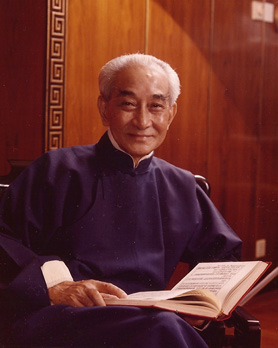
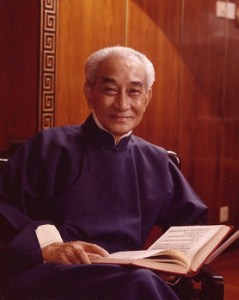
Nan Huaijin

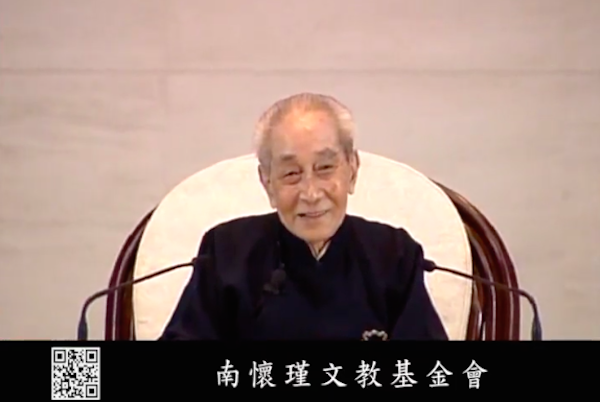
Nan Huaijin (Nan Huai-Chin), who passed away not long ago, was a recognised vajra master in Buddhism, but was unusual in that he was also thoroughly schooled in Confucianism and Daoism.

This poem from Zhang Bo-Duan (author of the Wu Zhen Pian: Understanding Reality, one of the most famous classics of Daoist alchemy) was explained by Master Nan during a seven day Zen retreat held in China.

Mater Nan led into the discussion by comparing modern physical science and Buddhist sciences:

“Studying Buddhism is a science of life. It is different to natural science in that it does not use the physical things of the external world, but instead uses the functions of one’s own body, the five sense organs, and the biggest organ, that of the brain. But it is using the brain to turn around and investigate itself, the mind to turn around and look for one’s own mind within.

There is a Daoist, one of the patriarchs of the Southern school, Zhang Zi-Yang (Zhang Boduan). A Daoist, yet he was also thoroughly versed in Buddhism, especially Chan in which he was a high illuminate. This True Man, Zhang Ziyang, wrote a truly excellent poem about the experience of quiet sitting in Chan.

心内观心觅本心

xīn neì guān xīn mì běn xīn

Observe the mind within the mind to search for the root mind.

This is what we were just speaking about: turning around to look for one’s own mind; interior observation of one’s heart, the effects of our thoughts and feelings. This is mind, the function of heart/mind.

When I say “heart” I do not mean the physical heart, it refers to what we now call the brain, the feelings, knowledge, sensations … all these caught up together is what we are calling heart/mind, this basic function.

Before we were born of our father and mother, before we had become a foetus, did this mind exist? This is what we are looking for, not what Western philosophy talks about as mind. What Western philosophy means by ‘mind’ is what is known in Buddhism as the function of the sixth consciousness: the thinking mind, the thoughts in the mind, that is the sixth consciousness.

It is not mind as a whole.

We are talking about mind as a whole.

心内观心觅本心

xīn neì guān xīn mì běn xīn

Observe the mind within the mind to search for the root mind.

Where is that original mind? What is the origin of the origin? Without my brain, without my body, where after all is that heart/mind?

Here is the second sentence:

心心俱绝见真心

xīn xīn jù jué jiàn zhēn xīn

Cutting off thought after thought, you will see the true mind

All the thoughts and feelings inside you, all that is happening, all come to rest, all quiet and still. Slowly, slowly, they all cease; totally and absolutely still and quiet, all errant thoughts stopping. Feelings, knowledge, everything, all rests.

“Perceiving the true heart/mind” (见真心jiàn zhēn xīn) – you can then observe your own true and proper fundamental origin (真正根源 zhēn zhèng gēn yuán), the function of the root mind.
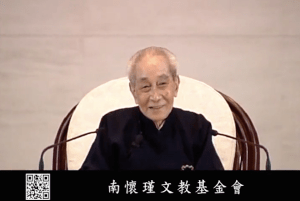
Nan Huaichin

The third sentence:

真心明徹通三界

Zhēn xīn míng chè tōng sān jiè

The true mind penetrates with clarity throughout the three realms 

If you can find the foundation of the root mind, the root essence (本性běn xìng), if you understand it, realise it, and truly verify it—not theoretically, mind you, but throwing your whole body and mind into this search to verify it—then one can transcend this material world, leap beyond the “three realms” (of desire, of form, and of formlessness). Hence “The true mind penetrates with clarity throughout the three realms. ” Then, he concludes:

外道邪魔不敢侵

waì daò xié mó bù gǎn qīn

Heretics and evil spirits dare not encroach.

Ghosts, devils, spirits, none of them dare to molest you. Zhang Zi-Yang was very well-known, an accomplished expert in both Buddhism and Daoism, in what they call the Southern School of Daoism. He was one of the patriarchs of this Southern School.


Observe the mind within the mind to search for the root mind.

Cutting off thought after thought, you will see the true mind.

The true mind penetrates with clarity throughout the three realms.

Heretic and evil spirits dare not encroach.
Understanding Reality

IMG_8162

Zhang Bo-Duan carefully composed the book Wu Zhen Pian (Understanding Reality) after trying three times to pass on his knowledge, and three times failing due to having chosen unsuitable people. In the postscript Zhang Boduan said

In this book of mine, everything is made ready for you, the verses and songs have the firing process of the great elixir, and all the subtle directions. Those who have an affinity for this matter must have the bones of a transcendent, then when they read this book carefully and with wisdom it will inspire clarity. They can search the text to unravel the significant meaning of terms, there will be no need for personal oral transmission by my humble self. This book is in fact a bequest from Heaven, not my own presumption.

To the Tune “Rain-soaked Bell”

qingming-2

A cicada’s chill keen broke the first pause in the hard rain.
This night, there is only your face.
Dismal drinks in the traveller’s tent by the city gate,
Boatmen anxious to push off in the lull
– still we hold back.

Shameless, we grip hands, tearful
And choked with silence.

The thought of going, going:
Haze like smoke over the water a thousand miles;
Dull cloud misting deep
The broad skies of the South.

Always and everywhere, severed love rends the heart
But at so bleak an autumn, utter torment.

Drunk tonight, where shall I wake?
Poplar and willow on the banks,
The rise of the dawn breeze
As the moon sets.

There will be so many years, and so many lovely scenes
— all empty;
And though there be
A thousand rousings of my heart
— with whom shall I share them?

Liu Yong   987-1053

This is a poem in the cí form (‘ci’ is pronounced like ‘tsih’) which borrowed popular tunes from Central Asia as a format for rhythm and structure upon which a new poem was constructed. The tempo and length could be either fast and short, or slow and long; this poem is an example of the latter, called màn cí.

Here is the poem in running script by the famous contemporary calligrapher Wang Dongling.

Liu Yong was a master, and some say the originator, of the long and slow form of ci poetry. (This was also the favourite form of Li Qing-Zhao, the great poetess). Liu travelled to the capitol Kai Feng to take the imperial examination. He failed each year, and remained to try again the next, until he was forty-seven. In between exams he spent much of his time in the urban pleasure centres, and many of his poems describe the lives of singers and courtesans, and the life of the emotions.

Simple in language, yet carefully crafted and hauntingly delicate, they remained widely popular for centuries, so that in the words of a later critic “the poems of Liu Yong are sung wherever a well has been dug.”

Ma Danyang’s teacher leaves a poem

IMG_8174師言:祖師嘗到登州時,頂笠懸鶉 ,執一節、攜一鐵觀,狀貌奇古,乞於市肆,登州人皆不識。夜歸觀,書一絕於壁:
一別終南水竹村,
家無兄女亦無孫。
數千里外尋知友,
引入長生不死門。

明旦拂衣束邁。後數日,郡守紇石烈邈詣觀,觀其題詩,欽歎不已。乃依韻和曰:

迴首三年別故村,
都忘庭竹長兒孫。
他時拂袖尋君去,
應許安閑一叩門。

Our teacher Ma Danyang told us:

The founding teacher Wang Chongyang once went to Dengzhou¹ wearing a large bamboo hat and a patched cloak, with a bamboo staff in one hand and an iron bowl in the other. He looked like something from an old legend. He went begging in the market, and no one in Dengzhou recognized him. In the evening he returned to the monastery and wrote a poem on the wall:

I left at last
The mountains of Zhongnan²
And my village of bamboo and water
Where no family remained —
Not brother nor daughter —

To search everywhere
For a knowing friend
That I may lead him
Or her³ to the gate
Of long life without death.

The next morning he shook out his sleeves and strode away.

A few days later, the local magistrate He Shilie arrived at the monastery from afar and saw the poem on the wall. He sighed, lost in admiration. Then he composed a matching poem, keeping to the same rhyme scheme:

You look back three years
When you left your hamlet
And your house, its courtyard
of bamboo, leaving your sons
and their sons.
But a time will come when I, too
Shaking out my sleeves, will search for you.
And will you, then, give leave for me
To cast off cares and knock at your gate?

from the Discourses of Ma Danyang

  1. On the coast of Shandong.
  2. As well as the place where Wang Chongyang founded the Complete Perfection school of Daoism, the Zhongnan mountains were the location of Louguantai  (楼观台), where Laozi traditionally was held to have transmitted the Dao De Jing to Yin Xi.
  3. This is not just modern political correctness. One of Wang Chongyang’s most famous disciples was Sun Bu-er–Sun the Inimitable–who was, as it happens, the wife of Ma Danyang.

Path of Clear Stillness

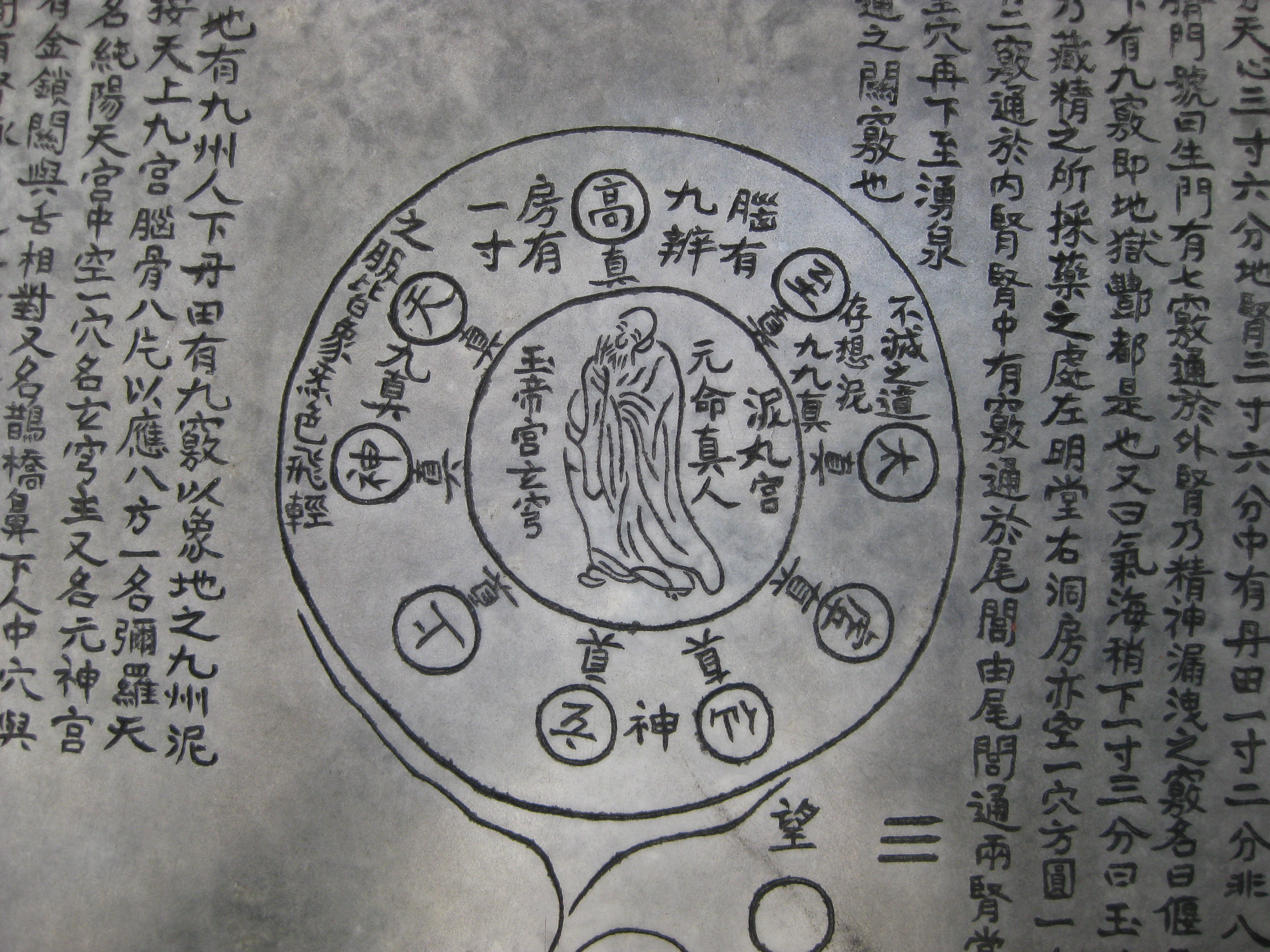
師曰:清靜之道,人能辨之,則盡善盡美矣。故經云:人能常清淨,天地悉皆歸。言天地者,非外指覆載之天地也,蓋指身中之天地也。人之膈已上為天,膈已下為地。若天氣降,地脈通,上下沖和,精氣自固矣。此小任仙所說也。

Our Teacher Ma Danyang said:

The Path of Clear Stillness, if people have discernment, is completely good and beautiful. So the Classic says If a person can be always clear and quiet, Heaven and Earth will revert completely.

Here, the meaning of ‘Heaven’ and ‘Earth’ is not the heaven covering us, or the earth supporting us, but the Heaven and Earth within us, in our body. Above the diaphragm is ‘Heaven’, below the diaphragm is ‘Earth.’ If Heavenly qi can descend, the channels of Earth will open, and above and below will course together harmoniously. In this way, vitality and qi will become consolidated by themselves. Anyway, this is how Xiao Ren Xian explains it.

The “Classic” mentioned is the Qing Jing Jing (清靜經).

Who exactly Xiao Ren Xian (小任仙) might be is so far unknown.

Since when is bowing a mistake?

师在东牟道上行。僧道往来者。识与不识。必先致拜。从者疑而问之曰。彼此俱昧平生。何用拜之。师曰。道以柔弱谦下为本。况三教同门异户耳。孔子言。谁执鞭之士。吾亦为之。未闻一拜之为一过。

Our teacher Ma Danyang was walking on the East Mou Road where monks and Daoists were going to and fro. Whether he recognised them or not, he would take the initiative and bow to them. His followers thought this was strange and said “All of these people are deluded, and have been all their lives. What is the use in bowing to them?”
He replied: “The Dao is soft and weak and rooted in lowness and humility. Furthermore the three religions have the same door, even if the houses are different. Confucius said ‘No matter how humble, if they have the Dao I would be willing to be as they are.’ And since when is bowing to someone a mistake?”

From the Talks of Ma Danyang

Three poems by Ma Danyang 馬丹陽 (1123-1184) for the instruction of his students

示门人三首

一思一虑觉分神,怎敢留心惹绊尘。

断制万缘混是假,修完一性泱全真。

Every thought and each worry can be felt dividing the spirit
Letting the mind adhere to them risks being bound by the world.
Assay the true, distinguish from the false amongst confused conditions
And refine to completion the single essence: great complete perfection.


人我关头生死关,劝人推倒我人山,

人我既除心性善,自然跳出死生圈。

The issue of self is the gate of life and death
The personal self is a mountain I urge you to beat down
The real self is nothing but eliminating mind to expose the essence of goodness
The leap beyond the circle of life and death then occurs naturally.


欲要元初一点明,须教猿马两停停。

心清意净三丹结,虎绕龙蟠四象成。

To ignite the primal light
Teach both monkey and horse to stop
Clear the mind, settle thought, and link all three elixirs.
Then tiger circles the twisting dragon,
And all the elements unite.


Ma Danyang taught that avoiding leakage was a key technique, even just for basic health:

Wasted jing, extinguished spirit — these simply lead to premature death. Those who would aspire to the Dao must avoid excess in this regard.

Others, of less intelligence, quip that the span of their life is set by fate, why not enjoy it?

But the old saying warns: when the oil dries up, the lamp goes out; when the marrow is exhausted, a person dies. You must know that jing/essence is the root and basis of your body — how long does a tree last when its root is cut away?

To nourish life, first treasure the jing/essence. When the jing/essence is full, qi will flourish, and then the spirit will be hearty, the body healthy, with few illnesses. The organs inside will function perfectly, the skin outside will glow, your visage will be bright, your eyes and ears and brain sharp! And all of this from reducing the wastage of jing/essence in your youth. If you have done this, and on top of this can reduce desire altogether, you will live a good long life.

But Ma was also a healer. The Grand Compendium of Acupuncture (Zhen Jiu Da Cheng (針灸大成) by Yang Jizhou records a collection of Ma Danyang’s acupuncture methods in a section called “The Poem of Ma Dangyang’s Twelve Heavenly Star Points for The Treatment of Miscellaneous Diseases”(馬丹陽天星十二穴治雜病歌).

The poem outlines a simple method of choosing 12 points from the upper and lower limbs to treat diseases of the whole body. The 12 points are :

ST-36 Zusanli (足三里); ST-44 Neiting (內庭); L.I.-11 Quchi (曲池);

LI.-4 Hegu (合谷); BL-40 Weizhong (委中); BL-57 Chengshan (承山);

LIV-3 Taichong (太沖); BL-60 Kunlun (崑崙); GB-30 Huantiao (環跳);

GB-34; Yanglingquan (陽陵泉); HE-5 Tongli (通里); LU-7 Lieque (列缺).

Coming home a stranger

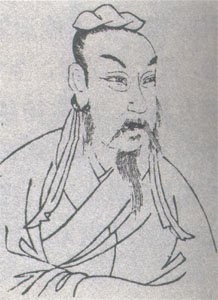
Hezhizhangpic

少小離家老大回,    

鄉音無改鬢毛

兒童相見不相識,    

笑問客從何處來。


Young, so young, when I left home

Now, so old, I return.

The lilt in their language

Has not changed;

It’s my beard that’s gone grey.

A man I knew when a child

Now smiles, and says :

‘Where are you from,

Stranger?’


The poet who wrote this, He Zhi-Zhang, lived from 659 to 744 in Zhejiang province. He was already famous in his youth for his poems and his big-hearted, broad-minded manner. He drank, joked and disputed with poets of the calibre of Li Bai and Du Fu.

He Zhi-Zhang’s easy-going manner while inebriated was portrayed in Du Fu’s poem entitled Song of the Eight Immortals at Drink.

He Zhi-Zhang was a Taoist and later disappeared into the countryside.

Again, Farewell — a Tang poem by Yu Xuanji

moutains in Taiwan copy

水柔逐器知難定,

雲出無心肯再歸。

惆悵春風楚江暮,

鴛鴦一隻失羣飛。


Water, being soft, seeks holding; 

But knows it won’t last.

Clouds disperse, and lack heart to return.


The spring day is over now, for this river; 

And the rueful wind goads

A widowed duck, lost amidst the sky.


This is the second poem that Yu Xuan-Ji entitled ‘Farewell,’ the first was published in the previous post, where the motif of dispersing clouds also appeared.

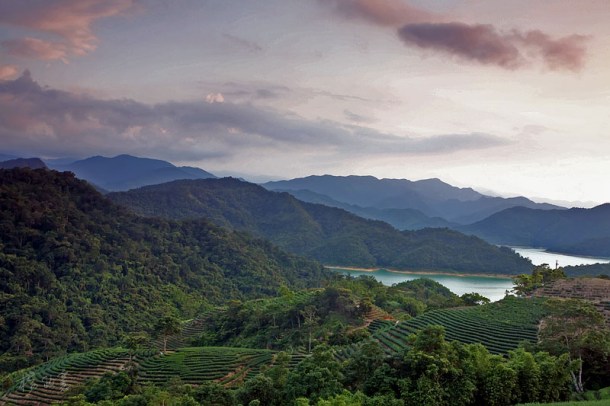
This subsequent poem is less intensely personal, and more abstract and philosophical: Yu writing about the same relationship perhaps after the passage of time. ‘Water seeking a vessel’ is a very Daoist image, as the Dao will flow into any receptive container; but the flow of attraction is very similar, and similarly impermanent—unless there is a heart. The clouds which disperse in both poems show Yu’s perception that ‘a lover’ is not just a body, but a total ambient presence of ideas and feelings and fragrances and visuals and more; unless ‘clouds’ can coalesce around a ‘heart’, they must disperse, with no return.

At the ‘turn’ of the poem, where the images change, we get the feeling that Yu is the river here, flowing within the banks of herself; the word chŭ 楚 (translated here as ‘goad’) is usually left out of translations of this poem, as the modern definitions do not seem to fit. But in ancient Chinese 楚 meant ‘thistles’ or ‘a handful of thistles used as a whip’. So while in the first poem her ‘wild moth’ of desire still fluttered dangerously around the lamp of love, even as that lamp faded and failed, here the full painful effect of these feelings torture her, she who is also the lone duck, the bereaved survivor of a pair of mandarin ducks, who in legend mate for life. The spring wind, by the way, is that which breaks up ice, dissolving connections.

(translation and comments by Steve Clavey)