Tag Archives: Daoist poetry

Ma Danyang’s teacher leaves a poem

IMG_8174師言:祖師嘗到登州時,頂笠懸鶉 ,執一節、攜一鐵觀,狀貌奇古,乞於市肆,登州人皆不識。夜歸觀,書一絕於壁:

一別終南水竹村,
家無兄女亦無孫。
數千里外尋知友,
引入長生不死門。

明旦拂衣束邁。後數日,郡守紇石烈邈詣觀,觀其題詩,欽歎不已。乃依韻和曰:

迴首三年別故村,
都忘庭竹長兒孫。
他時拂袖尋君去,
應許安閑一叩門。

Our teacher Ma Danyang told us:

The founding teacher Wang Chongyang once went to Dengzhou¹ wearing a large bamboo hat and a patched cloak, with a bamboo staff in one hand and an iron bowl in the other. He looked like something from an old legend. He went begging in the market, and no one in Dengzhou recognized him. In the evening he returned to the monastery and wrote a poem on the wall:

I left at last
The mountains of Zhongnan²
And my village of bamboo and water
Where no family remained —
Not brother nor daughter —

To search everywhere
For a knowing friend
That I may lead him
Or her³ to the gate
Of long life without death.

The next morning he shook out his sleeves and strode away.

A few days later, the local magistrate He Shilie arrived at the monastery from afar and saw the poem on the wall. He sighed, lost in admiration. Then he composed a matching poem, keeping to the same rhyme scheme:

You look back three years
When you left your hamlet
And your house, its courtyard
of bamboo, leaving your sons
and their sons.
But a time will come when I, too
Shaking out my sleeves, will search for you.
And will you, then, give leave for me
To cast off cares and knock at your gate?

from the Discourses of Ma Danyang

  1. On the coast of Shandong.
  2. As well as the place where Wang Chongyang founded the Complete Perfection school of Daoism, the Zhongnan mountains were the location of Louguantai  (楼观台), where Laozi traditionally was held to have transmitted the Dao De Jing to Yin Xi.
  3. This is not just modern political correctness. One of Wang Chongyang’s most famous disciples was Sun Bu-er–Sun the Inimitable–who was, as it happens, the wife of Ma Danyang.
Three poems by Ma Danyang 馬丹陽 (1123-1184) for the instruction of his students

示门人三首

一思一虑觉分神,怎敢留心惹绊尘。

断制万缘混是假,修完一性泱全真。

Every thought and each worry can be felt dividing the spirit
Letting the mind adhere to them risks being bound by the world.
Assay the true, distinguish from the false amongst confused conditions
And refine to completion the single essence: great complete perfection.


人我关头生死关,劝人推倒我人山,

人我既除心性善,自然跳出死生圈。

The issue of self is the gate of life and death
The personal self is a mountain I urge you to beat down
The real self is nothing but eliminating mind to expose the essence of goodness
The leap beyond the circle of life and death then occurs naturally.


欲要元初一点明,须教猿马两停停。

心清意净三丹结,虎绕龙蟠四象成。

To ignite the primal light
Teach both monkey and horse to stop
Clear the mind, settle thought, and link all three elixirs.
Then tiger circles the twisting dragon,
And all the elements unite.


Ma Danyang taught that avoiding leakage was a key technique, even just for basic health:

Wasted jing, extinguished spirit — these simply lead to premature death. Those who would aspire to the Dao must avoid excess in this regard.

Others, of less intelligence, quip that the span of their life is set by fate, why not enjoy it?

But the old saying warns: when the oil dries up, the lamp goes out; when the marrow is exhausted, a person dies. You must know that jing/essence is the root and basis of your body — how long does a tree last when its root is cut away?

To nourish life, first treasure the jing/essence. When the jing/essence is full, qi will flourish, and then the spirit will be hearty, the body healthy, with few illnesses. The organs inside will function perfectly, the skin outside will glow, your visage will be bright, your eyes and ears and brain sharp! And all of this from reducing the wastage of jing/essence in your youth. If you have done this, and on top of this can reduce desire altogether, you will live a good long life.

But Ma was also a healer. The Grand Compendium of Acupuncture (Zhen Jiu Da Cheng (針灸大成) by Yang Jizhou records a collection of Ma Danyang’s acupuncture methods in a section called “The Poem of Ma Dangyang’s Twelve Heavenly Star Points for The Treatment of Miscellaneous Diseases”(馬丹陽天星十二穴治雜病歌).

The poem outlines a simple method of choosing 12 points from the upper and lower limbs to treat diseases of the whole body. The 12 points are :

ST-36 Zusanli (足三里); ST-44 Neiting (內庭); L.I.-11 Quchi (曲池);

LI.-4 Hegu (合谷); BL-40 Weizhong (委中); BL-57 Chengshan (承山);

LIV-3 Taichong (太沖); BL-60 Kunlun (崑崙); GB-30 Huantiao (環跳);

GB-34; Yanglingquan (陽陵泉); HE-5 Tongli (通里); LU-7 Lieque (列缺).

Again, Farewell — a Tang poem by Yu Xuanji

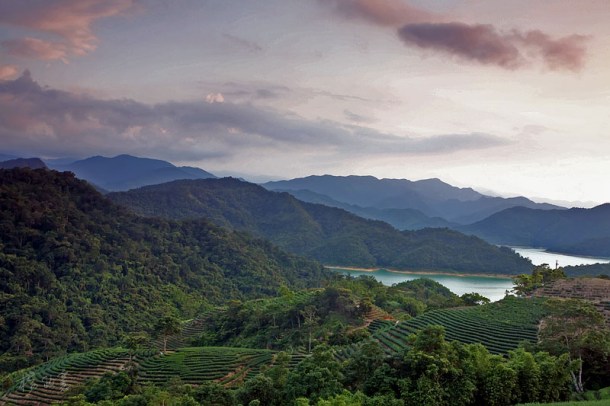
moutains in Taiwan copy

水柔逐器知難定,

雲出無心肯再歸。

惆悵春風楚江暮,

鴛鴦一隻失羣飛。


Water, being soft, seeks holding; 

But knows it won’t last.

Clouds disperse, and lack heart to return.


The spring day is over now, for this river; 

And the rueful wind goads

A widowed duck, lost amidst the sky.


This is the second poem that Yu Xuan-Ji entitled ‘Farewell,’ the first was published in the previous post, where the motif of dispersing clouds also appeared.

This subsequent poem is less intensely personal, and more abstract and philosophical: Yu writing about the same relationship perhaps after the passage of time. ‘Water seeking a vessel’ is a very Daoist image, as the Dao will flow into any receptive container; but the flow of attraction is very similar, and similarly impermanent—unless there is a heart. The clouds which disperse in both poems show Yu’s perception that ‘a lover’ is not just a body, but a total ambient presence of ideas and feelings and fragrances and visuals and more; unless ‘clouds’ can coalesce around a ‘heart’, they must disperse, with no return.

At the ‘turn’ of the poem, where the images change, we get the feeling that Yu is the river here, flowing within the banks of herself; the word chŭ 楚 (translated here as ‘goad’) is usually left out of translations of this poem, as the modern definitions do not seem to fit. But in ancient Chinese 楚 meant ‘thistles’ or ‘a handful of thistles used as a whip’. So while in the first poem her ‘wild moth’ of desire still fluttered dangerously around the lamp of love, even as that lamp faded and failed, here the full painful effect of these feelings torture her, she who is also the lone duck, the bereaved survivor of a pair of mandarin ducks, who in legend mate for life. The spring wind, by the way, is that which breaks up ice, dissolving connections.

(translation and comments by Steve Clavey)

Farewell — a Tang poem by the Daoist Yu Xuanji

Sunset in Taiwan

送别

秦樓幾夜愜心期,

不料仙郎有別離。

睡覺莫言雲去處,

殘燈一醆野蛾飛。


Those nights of pleasure at the pavilion –


         I never thought you could leave.


But clouds disperse, wordlessly,


         And I sleep alone;


still, around the wicked lamp, now fading,


         a wild moth flutters.


Yu Xuan-Ji (魚玄機) defies easy categorization. She was born in the Tang dynasty around 844 and died around 871, at the age of twenty-eight. Those 28 years however were a life lived to the fullest imaginable: she was well-educated, extremely intelligent, and consorted with a number of the famous poets of the Tang dynasty. The second wife of an official, she was driven away by the jealousy of the first wife, and apparently became a courtesan to survive; this in fact exposed her to the widest variety of culture and life. All of this is reflected in her poetry, of which we have 50-some poems still extant, and in which she explored not only a spectrum of metre and style, but what it means to be human. She was erudite yet plain, visual yet thoroughly versed in the language of the heart, and fearless in her political criticism.