Tag Archives: Wu Zhen Pian

Master Nan discusses a Daoist poem

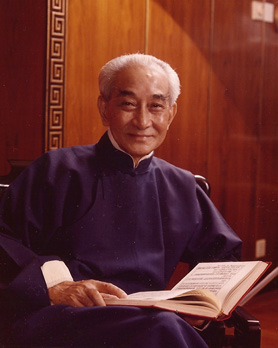
Nan Huaijin

Nan Huaijin (Nan Huai-Chin), who passed away not long ago, was a recognised vajra master in Buddhism, but was unusual in that he was also thoroughly schooled in Confucianism and Daoism.

This poem from Zhang Bo-Duan (author of the Wu Zhen Pian: Understanding Reality, one of the most famous classics of Daoist alchemy) was explained by Master Nan during a seven day Zen retreat held in China.

Mater Nan led into the discussion by comparing modern physical science and Buddhist sciences:

“Studying Buddhism is a science of life. It is different to natural science in that it does not use the physical things of the external world, but instead uses the functions of one’s own body, the five sense organs, and the biggest organ, that of the brain. But it is using the brain to turn around and investigate itself, the mind to turn around and look for one’s own mind within.

There is a Daoist, one of the patriarchs of the Southern school, Zhang Zi-Yang (Zhang Boduan). A Daoist, yet he was also thoroughly versed in Buddhism, especially Chan in which he was a high illuminate. This True Man, Zhang Ziyang, wrote a truly excellent poem about the experience of quiet sitting in Chan.

心内观心觅本心

xīn neì guān xīn mì běn xīn

Observe the mind within the mind to search for the root mind.

This is what we were just speaking about: turning around to look for one’s own mind; interior observation of one’s heart, the effects of our thoughts and feelings. This is mind, the function of heart/mind.

When I say “heart” I do not mean the physical heart, it refers to what we now call the brain, the feelings, knowledge, sensations … all these caught up together is what we are calling heart/mind, this basic function.

Before we were born of our father and mother, before we had become a foetus, did this mind exist? This is what we are looking for, not what Western philosophy talks about as mind. What Western philosophy means by ‘mind’ is what is known in Buddhism as the function of the sixth consciousness: the thinking mind, the thoughts in the mind, that is the sixth consciousness.

It is not mind as a whole.

We are talking about mind as a whole.

心内观心觅本心

xīn neì guān xīn mì běn xīn

Observe the mind within the mind to search for the root mind.

Where is that original mind? What is the origin of the origin? Without my brain, without my body, where after all is that heart/mind?

Here is the second sentence:

心心俱绝见真心

xīn xīn jù jué jiàn zhēn xīn

Cutting off thought after thought, you will see the true mind

All the thoughts and feelings inside you, all that is happening, all come to rest, all quiet and still. Slowly, slowly, they all cease; totally and absolutely still and quiet, all errant thoughts stopping. Feelings, knowledge, everything, all rests.

“Perceiving the true heart/mind” (见真心jiàn zhēn xīn) – you can then observe your own true and proper fundamental origin (真正根源 zhēn zhèng gēn yuán), the function of the root mind.
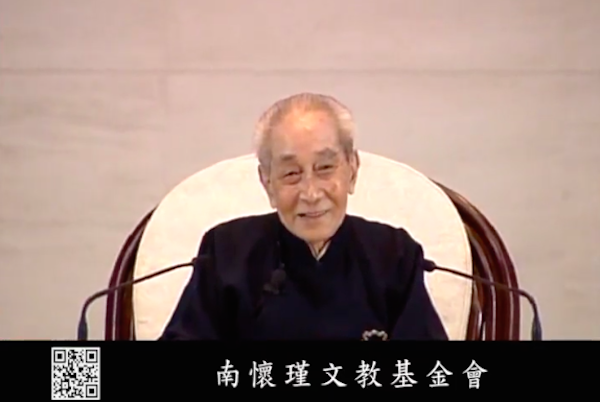
Nan Huaichin

The third sentence:

真心明徹通三界

Zhēn xīn míng chè tōng sān jiè

The true mind penetrates with clarity throughout the three realms 

If you can find the foundation of the root mind, the root essence (本性běn xìng), if you understand it, realise it, and truly verify it—not theoretically, mind you, but throwing your whole body and mind into this search to verify it—then one can transcend this material world, leap beyond the “three realms” (of desire, of form, and of formlessness). Hence “The true mind penetrates with clarity throughout the three realms. ” Then, he concludes:

外道邪魔不敢侵

waì daò xié mó bù gǎn qīn

Heretics and evil spirits dare not encroach.

Ghosts, devils, spirits, none of them dare to molest you. Zhang Zi-Yang was very well-known, an accomplished expert in both Buddhism and Daoism, in what they call the Southern School of Daoism. He was one of the patriarchs of this Southern School.


Observe the mind within the mind to search for the root mind.

Cutting off thought after thought, you will see the true mind.

The true mind penetrates with clarity throughout the three realms.

Heretic and evil spirits dare not encroach.
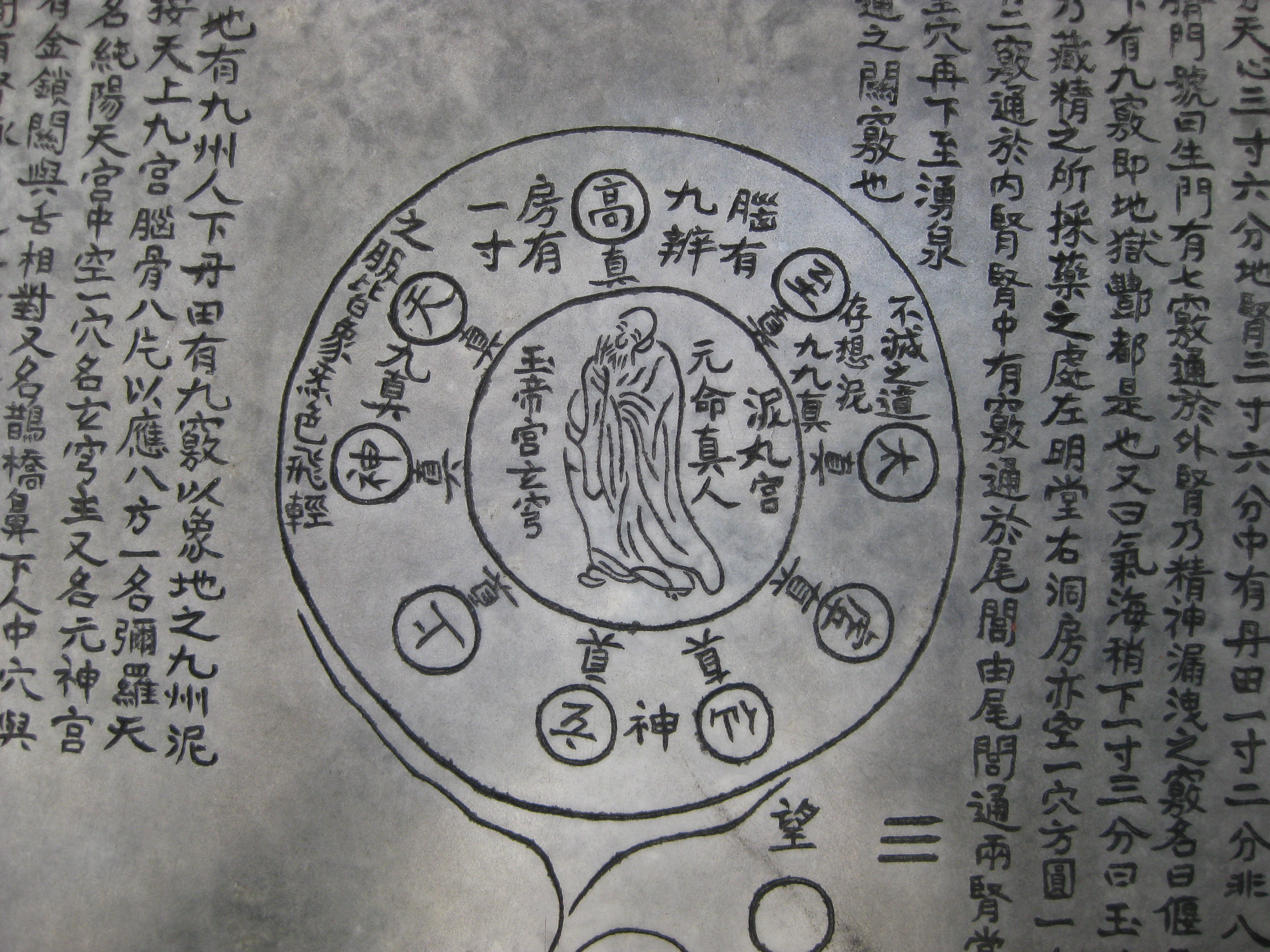
Understanding Reality

IMG_8162

Zhang Bo-Duan carefully composed the book Wu Zhen Pian (Understanding Reality) after trying three times to pass on his knowledge, and three times failing due to having chosen unsuitable people. In the postscript Zhang Boduan said

In this book of mine, everything is made ready for you, the verses and songs have the firing process of the great elixir, and all the subtle directions. Those who have an affinity for this matter must have the bones of a transcendent, then when they read this book carefully and with wisdom it will inspire clarity. They can search the text to unravel the significant meaning of terms, there will be no need for personal oral transmission by my humble self. This book is in fact a bequest from Heaven, not my own presumption.

The Magic Sword passage from the Wu Zhen Pian (Understanding Reality)

歐冶親傳鑄劍方,鏌鋣金水配柔剛。

煉成便會知人意,萬里誅妖一電光。


Ou Ye personally transmitted a method for casting a sword; 

Mo Ye, with metal and water, alloyed flexibility and strength.

When the forging is complete, it can read people’s minds; 

A flash of lightning, slaying demons for ten thousand miles.

Cleary translation¹


Zhu Yuanyu’s commentary

This passage is discussing the use of the golden elixir sword of wisdom. It is meant to be employed together with the previous passages discussion of ‘bathing.’ When the ancient teachers reached this point, they would be unable to suppress a smile, due to the strange coincidence of legends of miraculous physical swords which were analogies of the golden elixir’s non-physical sword of wisdom.

Now the method of forging these swords requires rigorous tempering with metal and water to complete them; the work of congealing the elixir likewise must be obtained through refining metal and water. The true qi of the two arcs² of metal and water, one hard and the other soft, combine to form the elixir. This exactly resembles the miraculous sword which was created via the pairing of Gan Jiang and Mo Ye, which formed the treasure. The subtle employment of the two arcs requires oral instruction by a true teacher, which again resembles the necessity for Ou Ye to pass on the subtle secrets of forging swords. This is why the passage says:

Ou Ye personally transmitted a method for casting a sword; 

Mo Ye, with metal and water, alloyed flexibility and strength.

When the qi of the two arcs is subtly joined and congealed, then the true fire of the oven of Kun tempers and refines it, transforming them into one qi, making a sharp sword that can cut a floating hair. This is called the sword of wisdom. The edge of this sword cannot be touched, lest you lose your life.

The marvel is in the three words Knowing Human Intent.³ “Intent” () is the true ruler of the yellow centre. Intent is this sword, the sword is Intent: there it stands before your eyes, but if you don’t see it, it might as well be ten thousand miles away.

At the time when the great medicine must enter the oven, if yin demons come to interfere, then use the sword of wisdom to its utmost, hitting them right on the head with the first stroke, immediately clearing even their shadows away. This is why the passage says:

When the forging is complete, it can read people’s minds

 A flash of lightning, slaying demons for ten thousand miles.

The first two sentences discuss the structure of the sword of wisdom, the last two lines discuss its use. Note that there is not really a sword of wisdom that one can use, it is actually nothing but the single point of spiritual light from the primal heaven.† And there are not really demons to put to death: they are but the first stirrings you feel of thoughts—it is another way of stating [what is suggested in the second line of the the hexagram Qian in the Yi Jing]: “eliminate the false”.

Ancestor Lü says about this very same sword: “I do have a sword, but it is different to the usual: first it cuts off greed, then it cuts off desire, and finally it cuts off all mental disturbance. That is my triple sword-play.”

This the the sword he was talking about.

Footnotes

1. This translation of the original verse is from Cleary’s Understanding Reality, page 111, where the verse has Liu Yiming’s commentary appended. It may be useful to compare Liu Yiming’s commentary with Zhu Yuanyu’s included here, in order to form a more complete picture of the meaning. For example, Liu explains the story of Mo Ye: “In ancient times there was a smith named Ou Ye: as he was casting a sword, it repeatedly failed to to turn out; his wife, Mo Ye, jumped into the forge and the work was accomplished in one firing. People called it the precious sword of Mo Ye, It was incomparably sharp.”

2. The “two arcs” are the ascending arc of the waxing moon and the descending arc of the waning moon, symbolising the growth of metal on the left and the descent of water on the right.

3. 知人意。Cleary translates this as “read people’s minds.”

†. 先天一点灵光。

Zhū Yuányù (朱元育) comments on a verse of the Wù Zhēn Piàn

The words of the myriad books on immortality are all the same – the golden elixir alone is the root source.

The substance is produced on the ground of the position of EARTH planted in the chamber of intercourse in the house of HEAVEN,

Do not think it strange that the celestial working has been leaked – it is because students are confused and ignorant.

(Understanding Reality, Cleary translation, p. 54)

This verse talks of the great way of the golden elixir, of transcending the common and entering the path of the sages. It is the final verse in the initial sequence of the Wù Zhēn Piàn.

The previous verses spoke of how the effect of the golden elixir was vastly superior to that of the side tracks, and how one could see that only this matter is factual, no other way was real. But it is not only this book, the Wù Zhēn Piàn, that states this: each of the ten thousand classics of elixir are concerned only with this single matter.

The pre-heaven Yì Jīng of Fúxī brings up Qián, Kun, Kăn and ; he was the elder pioneer who cleared the mountain for this temple of elixir classics. The Dào Dé Jīng and Qīng Jìng classics solely model themselves on Being-as-is. Although they directly point to the path of wúwéi, the effect of the golden elixir is already there within.

The books of Yīn Fù and Cān Tóng want people to return to their root, and although they detail practices that are yŏuwéi (ie, active as opposed to wúwéi), yet the effect in the final analysis still comes back to the great way of Being-as-is.

And everything that Zhuāngzi and Lièzi and the Wénshì Jīng expounded comes back to this, and what Zhōnglĭ Quán and Master Sea Toad described—all are just this: investigating the root of Essence and Life in order to set up the principle of the golden elixir. And as for the saying “only the golden elixir is worthwhile,” this is the root source.

The effect of the golden elixir is explained in detail within the text, but the gist of it is merely to produce medicine in the furnace of Kūn (坤爐) and congeal the fetus in the cauldron of Qián (乾鼎). These two phrases cover it all.

In terms of the golden elixir, the great medicine is produced when Kăn and start to interact—this is the work in the palace of Kūn. As to culling according to the time, ascending to the entrance of the Celestial Valley, and guiding the return to the Yellow Court, these are all in the household of Qián.

In terms of elixir reversion (还丹), it is using a gentle fire to warm and nourish the medicine that has been gathered into the furnace; again, work in the palace of Kūn. As to the practice of concentrating fire and metal in close interaction at the peak of Kūnlún, this too is in the household of Qián.

When Master Cui said the birth is from Kūn, the seed is from Qián he was referring to all the above. This is why the line in the text here says The substance is produced on the ground of the position of EARTH (Kūn) planted in the chamber of intercourse in the house of HEAVEN (Qián).

Exposing things to this extent, Master Zhāng could be said to have openly revealed the secret Celestial mechanism. Yet worldly people still are misled by side-tracks! They might take, for example, ‘you’ and ‘I’ as Qián and Kūn, a mistake which destines  them for the lowest reach of hell. Or they might take ‘above the navel’ and ‘below the vertex’ in the body as Qián and Kūn, thus working their way toward the ghost cave at Black Mountain (黑山鬼窟). Isn’t this the ultimate stupidity?