Monthly Archives: June 2014

The thing about Jing

In a previous post we looked at jing/essence as a trust fund of inherited constitutional energy, intended to be used for procreation and emergencies only, but regularly wasted through failure to understand that:

a) it is not infinite, and

b) it can only be replaced through long-term quiet accumulation in the midst of stillness.

Jing/essence is, in fact, the power of our youth. Those with less age quickly.

Chen Zhi-Xiu (Shang Yang-Zi) quotes the Daoist acupuncturist Ma Dan-Yang about its importance:

The most precious thing people have is jing/essence, but it is very limited … [Ma] Dan-Yang says ‘Sex is worse than tigers or wolves, it destroys a person’s beauty and bearing, it ruins good actions. Wasted jing, extinguished spirit — these simply lead to premature death. Those who would aspire to the Dao must avoid [excess in this regard].’*

Chen goes on to say:

Others, of less intelligence, quip that the span of their life is set by fate, why not enjoy it? But the old saying warns: when the oil dries up, the lamp goes out; when the marrow is exhausted, a person dies. You must know that jing/essence is the root and basis of your body — how long does a tree last when its root is cut away?’ To nourish life, first treasure the jing/essence. When the jing/essence is full, qi will flourish, and then the spirit will be hearty, the body healthy, with few illnesses. The organs inside will function perfectly, the skin outside will glow, your visage will be bright, your eyes and ears and brain sharp! And all of this from reducing the wastage of jing/essence in your youth. If you have done this, and on top of this can reduce desire altogether, you will live a good long life.

It is not only ejaculation that wastes jing/essence: anything that disturbs its quiet repose and incites it to movement has already caused wastage of the jing, as it has become transformed into active energy waiting to be used. Jing is potential. Once this source has been tapped, that activated energy cannot be easily transformed back into the potential which was.

So what disturbs jing? Anything that excites desire, especially sexual desire, disturbs jing. Little desires cause little disturbance, the greater the desire, the greater the disturbance to the jing/essence. Desires modified by control are much less disrupting.

This whole concept, of course, is anathema to a consumer-driven society (or at least to the information media fueled by advertising), which is why these sorts of ideas are not very popular, but we should be able to see that in fact unbridled craving for things is ultimately weakening for the whole society: less essence, less spirit, less will.

This idea, that desire which is not skillfully controlled will easily drain jing/essence, also shows up the potential danger in the “Taoist sexual techniques” advocated by so many popular books — dangers in fact warned against for centuries by Daoists themselves. Thomas Cleary’s Sex, Health and Long Life provides a balanced introduction to the topic.

And how do we build up jing/essence, then? Well, how about a little peace and quiet, first …
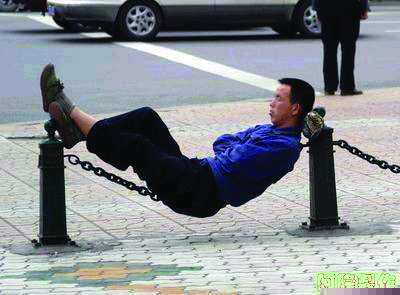
Xiaoyao building up his jing/essence

Xiaoyao building up his jing/essence …


* 盖色之害人,甚于狼虎,败人美行,损人善事,亡精灭神,至于损躯,故为道人之大孽。

Two Letters of Liu Yiming

A letter in answer to General Su

Yesterday at the provincial capital  you honoured me with your elder presence and did not disdain the wilds of the mountains for our talk, and the [Daoist] mnemonic rhymes you passed on I have found very beneficial.

It is true when they say “when old friends meet, the warmth exceeds all class distinctions.”

When this patch-robed monk  was young, I had no discernment of what was deviant or correct. I would ask anyone and study anything, one day with Wang, another day with Li, a little bit of one thing then a little bit of something else.

Nothing came of this.

Then I met a Daoist who taught stillness techniques and …

Two Letters of Liu Yi Ming

(translated by Xiaoyao, these letters have, as far as we know, not been previously translated into English)

Only three sources of energy

People often ask why they are no longer as fertile as they were in their twenties. “I mean, I am only 35, its not like I’m old or anything. Why should I be less fertile than when I was 25, or even 20?”

In attempting to answer this question over the years, a diagram emerged (below) that illustrated the situation in financial terms. This seemed to be the most understandable for people. But just by the way it also illustrated the need for yang sheng practices: practices that nourish life, regular practices that reduce the leakage of jing, qi, and shen: vital essence, energy, and spirit.


Three Sources of Energy diagram
Air             from           Lungs
Income                                      Food and drink       from         Spleen

Inherited Trust Fund                 Inherited jing/essence         Kidneys


We have only three sources of energy: the air that we breath, the food that we eat, and the inherited jing/essence which is stored in the Kidneys. It is this last which supports our growth in our mother’s womb until we are born, and then continues to support the growth of the bones of our frame until we are more or less fully grown. This inherited jing/essence then turns into our own reproductive energy. Like a family trust fund passed down the generations, intended to be preserved and increased, the jing should be employed only for reproductive purposes or for emergencies, while we live day-to-day on our ‘income’: the air and food we take in.

But we don’t.

We, like little rich kids bedazzled with our wealth, spend beyond our income, and simply borrow from our trust fund whenever we need more energy  or simply want a ‘buzz’. This in fact is the tell-tale sign that we are borrowing from the Kidney jing: instead of the normal feeling of quietly sufficient energy, we get the fine tremor, the ‘rush’, and even occasionally palpitations and insomnia when we really overdo it.
Coffee and other stimulants do not give us energy, they simply facilitate a loan from the trust fund.
This trust fund is not bottomless, however, as much as it may seem so in our 20s: we begin to notice that our hair or skin is not so shiny or resilient, we don’t heal as well as before, and in fact, we are aging.

Shock.

It’s an even greater shock when (or more like ‘if’) we ever think through the consequences of the scenario:
a) We have never lived solely on our ‘income’, and b) We have been borrowing steadily from our trust fund, but c) This is now depleted, so d) We are forced to live on our income, but e) We still spend at the same rate.

No wonder things are breaking down! And they can only break down so far, before …

The Daoists, among others, very early on saw the way this scenario played out, and decided to take steps. Over the centuries they researched and developed a variety of methods for turning this process of depletion around, starting with reducing the loss of whatever jing/essence still remains, then starting to replace it.
Kidney jing/essence can be replaced, built up again, but it is a slow process because this energy is a reservoir of concentrated potential, whose main defining characteristic is accumulation in stillness, over a long period.

Unfortunately for us, stillness over any period of time is not a feature of Western society, and lest we be consumed in the fires of our own mad activity we desperately need to learn and practise these life nourishment techniques that the Daoists (and others) have developed and preserved for us, the later generations.

As the Daoists would say, if we can extend our lifespan we might have a chance of learning something worthwhile …

Review: Thomas Cleary’s Vitality, Energy and Spirit

Review:  Thomas Cleary’s

Vitality, Energy and Spirit

and

Taoist Meditation

When I first noticed Thomas Cleary’s wide range of translations from Buddhism, Daoism, Confucianism, and later Islam, I was dismissive: ‘Too many books,” I thought, vaguely, something along the lines of ‘jack of all trades, master of none.’ Furthermore, looking into these books, they did not have the detailed endnotes of the scholar, despite his PhD from Harvard: why this Chinese character was chosen for this sentence, instead of that; what other authorities thought and said.
“Shallow,” was my judgement.

After having it brought to my attention that such a judgement might be hasty, and over the intervening years having perhaps matured, to an extent, in my appreciation of some things, a revisiting of the Cleary books brought a very different conclusion. That conclusion, steadily reinforced with the passage of time, was that these translations are an accurate conveyance of the original practical intent of the texts he has chosen to translate; not simply translations of the words, but a conveyance of the heart of the text, the underlying meaning, done by someone who understands that meaning.

He recounts in the afterword to one of these books that this understanding came from

… my own introduction to the golden flower practice of “turning the light around,” long before I knew of the existence of this particular book [the Secret of the Golden Flower]. Finding this method of mindfulness extremely powerful and versatile, I subsequently spent many years studying its use in experience and looking for tested information pertaining to its objective application.

Cleary found that similar techniques of mindfulness played an important role in many if not all religions, although ‘dressed’, as it were, in very different costuming. Peeling away the packaging revealed a surprising identity of content within these religions, albeit expressed with characteristics determined by the culture: quiet, simple and practical for Chinese, for example, while the Indians might express the same core experience in colourful emotional ways.

In short, it seems to me there is a fair chance that Cleary knows what he is talking about, from experience. The texts are practical, that is, intended to be used. This is explicitly stated in his book Immortal Sisters: secret teachings of Taoist women:

The present volume addresses itself to individual pragmatic issues, and not to the sociology and politics of times gone by, for the simple reason that it is only by tackling practicalities on an individual level that the living element of Taoism can be brought out of past history and localized culture into the present reality of everyday life. This means seeking the essential rather than the incidental, the fundamentals rather than the outgrowths, that which applies to the human mind itself rather than to a specific mentality alone.

In other words, Cleary is of the opinion that it may be more valuable to learn to access the living flow which gives rise to Daoism and equivalent streams, a flow which is present now, rather than simply try to look like or act like a 12th century Daoist.

In the Taoist series, probably the best books to begin with are Vitality, Energy, Spirit: a Taoist Sourcebook, and Taoist Meditation. The former has selections spanning the whole history of Daoist thinking, in particular regarding Jing/essence (vitality), Qi (energy) and Shen (spirit), their appreciation, conservation, cultivation and ultimate unification.

In the much shorter Taoist Meditation, Cleary says:

Meditation is one element of Taoism that interests a broad spectrum of people, because the state of mind is central to the well-being and efficiency of the whole organism. Taoist meditation is for enhancement of both physical and mental health, as these two facets of well-being are intimately related to one another.

The practicality of these texts is shown in the clear directions provided for checking one’s own progress, and warning indications for when things are going wrong. An example is in this excerpt from the Tang dynasty Sima Chengzhen’s Treatise on Sitting Forgetting:

As long as the mind does not stick to things, and you can remain unmoved, this is the correct foundation for genuine stabilization. If you stabilize the mind by this means, your mood will become harmonious; the longer you do so, the lighter and fresher you feel. If you use this as a test, error and truth become evident.
If you extinguish the mind whenever it is aroused, without distinguishing right from wrong, then you will permanently cancel awareness and enter into blind trance.
If you just let your mind be aroused without collecting or controlling it at all, then you are after all no different from an ordinary mortal.

Then there are the “Sayings of Master Danyang”, from Ma Dan-Yang, whose “Song of the 12 Heavenly Star Points” is an acupuncture classic.

Here are two selections:

The energy in the body should not be scattered, the spirit in the mind should not be dimmed.
How do you avoid scattering energy?
By not acting compulsively.
How do you avoid dimming the spirit?
By not keeping things on your mind.

If people can master the path of purity and serenity, that is most excellent. Therefore scripture says, “If people can always be pure and serene, heaven and earth will resort to them.”
This ‘heaven and earth’ does not mean the external sky and ground. It refers to the heaven and earth in the body.
Above the solar plexus is called heaven, below the solar plexus is called earth. If the energy of heaven descends and the vessel of earth opens, so that there is harmony above and below, then vitality and energy spontaneously stabilize.