Chinese medicine is a treasure house, Mao told us, and so it has proven. For those of us in the profession it provides, at the least, a means of making a reasonable living in a satisfying and ethical way. But the more one engages with it, the more Chinese medicine reveals itself as a truly vast storehouse of treasures, each separate room an inexhaustible cornucopia of ways to improve the quality of living for oneself and others.
A separate room may be a specialty within the formal medical structure, such as paediatrics or ophthalmology, or it may be an area of investigation, such as herb growing and harvesting. Some rooms are larger than others. A small but very popular room is accessed by the billions who utilise some aspect of Chinese food therapy. We in the West have just barely peeked around the edge of the door in some rooms: an example of this is the meteorological–medical theory wuyun liuqi.
Indeed, we may find that exploration of this vast storehouse transforms us as we go, makes demands upon us that alter the way we experience ourselves and the world, challenges and changes our assumptions about how we as humans function, why we are, and even the boundaries of our skin.
One of the major halls in this storehouse is the experiential knowledge of the flow of qi around the body, both within and without the channels. We could almost call it the Hall of Qi, as it is an area that has led to the development of acupuncture, shiatsu, and qi gong, not to mention most of the Chinese martial arts. Involvement with qi gong or the martial arts (especially those known as “internal’” that put a premium on the development of proprioceptive awareness) will after a period of time — generally five years or so — find one developing an awareness of the circulation of qi, one that is not imagined or forced, but rather quite natural.
An older acupuncture teacher in China, who had also practised tai chi for a number of years, was incredulous when her new foreign students kept asking questions like: but how do you know the acupuncture points and channels are here, in this spot, and not somewhere else? She finally said, exasperated: “But can’t you feel it?”
It starts to look as though we, the modern sophisticates, are the ones who lack refinement in this area. Is it possible that there are ways of feeling and sensing that are simply not developed in our culture, while being so commonplace in other cultures that they are taken for granted?
As we get better at this, we may find that Chinese medicine students can learn in the body, instead of just in the head; that qi gong or tai chi or other internal martial arts will be core subjects taught by experts, rather than electives. At the moment, we should certainly be increasing the awareness of the part that yang sheng (life nourishing) exercises can play, not only in keeping practitioners healthy, but in fostering a deeper, more palpably experiential understanding of their art.
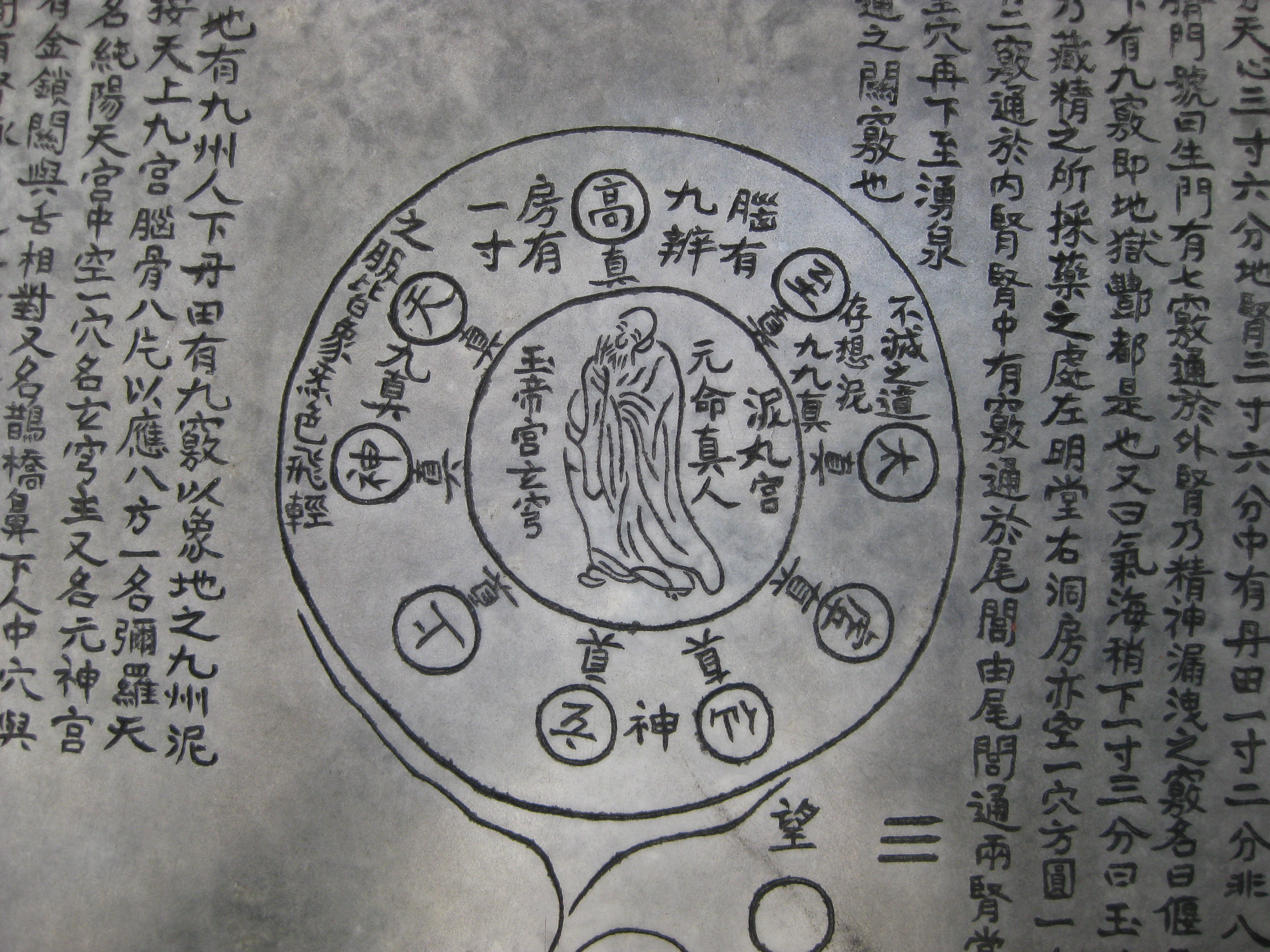
It is easy to wander from that Hall of Qi into an adjoining palace called Daoism (which Mao, strangely enough, never mentioned) — the two buildings share a non–existent wall.
While Chinese medicine has informed Daoism from the earliest times, the influence flowed strongly both ways. Many of the best known early authors in our medicine were as well–known for their Daoist works as for their medical texts, and these include such heavyweights as Ge Hong (Zhou Hou Bei Ji Fang), Tao Hongjing (Ming Yi Bie Lu, Ben Cao Jing Ji Zhu), Sun Simiao (Qian Jin Yao Fang), Meng Shen (Shi Liao Ben Cao) and even the famed Tang dynasty commentator on the Huang Di Nei Jing, Wang Bing, whose standard version we still use today.
All of these authors have works discussing the practice of Daoism. This pattern continues throughout the history of TCM: Ma Danyang (to name a single further example) is the compiler of the Ma Danyang’s 12 Heavenly Star Points of Acupuncture song (Ma Danyang Tian Xing Shi Er Xue Ge) but he is even better known as one of the seven illustrious disciples of Wang Chongyang, along with his famous wife Sun Buer — Sun the Inimitable.
The point of this retro romp is to flag this connection between Chinese medicine and Daoism, for the few who may not be aware of it, and to perhaps pique the curiosity — why is the connection so strong? Did the Daoists, those early scientists, discover in their investigations not only better herbal medicines and more effective uses of points, but other things that improved their medicine?
Those interested in delving deeper should read the book review section, where several of Thomas Cleary’s books on Daoism were introduced.

 The Fat Monk