Tag Archives: Daoism

Huang Yuanji comments on Laozi Chapter Six (“The Valley Spirit Does not Die”)

(excerpt)

If people want to refine elixir to attain the Way of long life and eternal vision, there is no path without this mysterious female. Is this not the root of heaven and earth?

When practitioners lower their eyelids and turn the light around to become like Hundun– undifferentiated wholeness without knowledge–it causes the ordinary mind to die. Suddenly there is a feeling and a movement, activating unified awareness. 

This gives birth to the mind of the Way. This is what is meant by being the original spirit in stillness, and becoming true intent in action.

Once foetal breathing moves, do not keep intensely fixated on the Dan Tian. Be poised neither inside nor outside while observing its ascent and descent, coming and going. Relaxed and lively, you can then attain true foetal breathing.

Since when is bowing a mistake?

师在东牟道上行。僧道往来者。识与不识。必先致拜。从者疑而问之曰。彼此俱昧平生。何用拜之。师曰。道以柔弱谦下为本。况三教同门异户耳。孔子言。谁执鞭之士。吾亦为之。未闻一拜之为一过。

Our teacher Ma Danyang was walking on the East Mou Road where monks and Daoists were going to and fro. Whether he recognised them or not, he would take the initiative and bow to them. His followers thought this was strange and said “All of these people are deluded, and have been all their lives. What is the use in bowing to them?”
He replied: “The Dao is soft and weak and rooted in lowness and humility. Furthermore the three religions have the same door, even if the houses are different. Confucius said ‘No matter how humble, if they have the Dao I would be willing to be as they are.’ And since when is bowing to someone a mistake?”

From the Talks of Ma Danyang

Three poems by Ma Danyang 馬丹陽 (1123-1184) for the instruction of his students

示门人三首

一思一虑觉分神,怎敢留心惹绊尘。

断制万缘混是假,修完一性泱全真。

Every thought and each worry can be felt dividing the spirit
Letting the mind adhere to them risks being bound by the world.
Assay the true, distinguish from the false amongst confused conditions
And refine to completion the single essence: great complete perfection.


人我关头生死关,劝人推倒我人山,

人我既除心性善,自然跳出死生圈。

The issue of self is the gate of life and death
The personal self is a mountain I urge you to beat down
The real self is nothing but eliminating mind to expose the essence of goodness
The leap beyond the circle of life and death then occurs naturally.


欲要元初一点明,须教猿马两停停。

心清意净三丹结,虎绕龙蟠四象成。

To ignite the primal light
Teach both monkey and horse to stop
Clear the mind, settle thought, and link all three elixirs.
Then tiger circles the twisting dragon,
And all the elements unite.


Ma Danyang taught that avoiding leakage was a key technique, even just for basic health:

Wasted jing, extinguished spirit — these simply lead to premature death. Those who would aspire to the Dao must avoid excess in this regard.

Others, of less intelligence, quip that the span of their life is set by fate, why not enjoy it?

But the old saying warns: when the oil dries up, the lamp goes out; when the marrow is exhausted, a person dies. You must know that jing/essence is the root and basis of your body — how long does a tree last when its root is cut away?

To nourish life, first treasure the jing/essence. When the jing/essence is full, qi will flourish, and then the spirit will be hearty, the body healthy, with few illnesses. The organs inside will function perfectly, the skin outside will glow, your visage will be bright, your eyes and ears and brain sharp! And all of this from reducing the wastage of jing/essence in your youth. If you have done this, and on top of this can reduce desire altogether, you will live a good long life.

But Ma was also a healer. The Grand Compendium of Acupuncture (Zhen Jiu Da Cheng (針灸大成) by Yang Jizhou records a collection of Ma Danyang’s acupuncture methods in a section called “The Poem of Ma Dangyang’s Twelve Heavenly Star Points for The Treatment of Miscellaneous Diseases”(馬丹陽天星十二穴治雜病歌).

The poem outlines a simple method of choosing 12 points from the upper and lower limbs to treat diseases of the whole body. The 12 points are :

ST-36 Zusanli (足三里); ST-44 Neiting (內庭); L.I.-11 Quchi (曲池);

LI.-4 Hegu (合谷); BL-40 Weizhong (委中); BL-57 Chengshan (承山);

LIV-3 Taichong (太沖); BL-60 Kunlun (崑崙); GB-30 Huantiao (環跳);

GB-34; Yanglingquan (陽陵泉); HE-5 Tongli (通里); LU-7 Lieque (列缺).

The Magic Sword passage from the Wu Zhen Pian (Understanding Reality)

歐冶親傳鑄劍方,鏌鋣金水配柔剛。

煉成便會知人意,萬里誅妖一電光。


Ou Ye personally transmitted a method for casting a sword; 

Mo Ye, with metal and water, alloyed flexibility and strength.

When the forging is complete, it can read people’s minds; 

A flash of lightning, slaying demons for ten thousand miles.

Cleary translation¹


Zhu Yuanyu’s commentary

This passage is discussing the use of the golden elixir sword of wisdom. It is meant to be employed together with the previous passages discussion of ‘bathing.’ When the ancient teachers reached this point, they would be unable to suppress a smile, due to the strange coincidence of legends of miraculous physical swords which were analogies of the golden elixir’s non-physical sword of wisdom.

Now the method of forging these swords requires rigorous tempering with metal and water to complete them; the work of congealing the elixir likewise must be obtained through refining metal and water. The true qi of the two arcs² of metal and water, one hard and the other soft, combine to form the elixir. This exactly resembles the miraculous sword which was created via the pairing of Gan Jiang and Mo Ye, which formed the treasure. The subtle employment of the two arcs requires oral instruction by a true teacher, which again resembles the necessity for Ou Ye to pass on the subtle secrets of forging swords. This is why the passage says:

Ou Ye personally transmitted a method for casting a sword; 

Mo Ye, with metal and water, alloyed flexibility and strength.

When the qi of the two arcs is subtly joined and congealed, then the true fire of the oven of Kun tempers and refines it, transforming them into one qi, making a sharp sword that can cut a floating hair. This is called the sword of wisdom. The edge of this sword cannot be touched, lest you lose your life.

The marvel is in the three words Knowing Human Intent.³ “Intent” () is the true ruler of the yellow centre. Intent is this sword, the sword is Intent: there it stands before your eyes, but if you don’t see it, it might as well be ten thousand miles away.

At the time when the great medicine must enter the oven, if yin demons come to interfere, then use the sword of wisdom to its utmost, hitting them right on the head with the first stroke, immediately clearing even their shadows away. This is why the passage says:

When the forging is complete, it can read people’s minds

 A flash of lightning, slaying demons for ten thousand miles.

The first two sentences discuss the structure of the sword of wisdom, the last two lines discuss its use. Note that there is not really a sword of wisdom that one can use, it is actually nothing but the single point of spiritual light from the primal heaven.† And there are not really demons to put to death: they are but the first stirrings you feel of thoughts—it is another way of stating [what is suggested in the second line of the the hexagram Qian in the Yi Jing]: “eliminate the false”.

Ancestor Lü says about this very same sword: “I do have a sword, but it is different to the usual: first it cuts off greed, then it cuts off desire, and finally it cuts off all mental disturbance. That is my triple sword-play.”

This the the sword he was talking about.

Footnotes

1. This translation of the original verse is from Cleary’s Understanding Reality, page 111, where the verse has Liu Yiming’s commentary appended. It may be useful to compare Liu Yiming’s commentary with Zhu Yuanyu’s included here, in order to form a more complete picture of the meaning. For example, Liu explains the story of Mo Ye: “In ancient times there was a smith named Ou Ye: as he was casting a sword, it repeatedly failed to to turn out; his wife, Mo Ye, jumped into the forge and the work was accomplished in one firing. People called it the precious sword of Mo Ye, It was incomparably sharp.”

2. The “two arcs” are the ascending arc of the waxing moon and the descending arc of the waning moon, symbolising the growth of metal on the left and the descent of water on the right.

3. 知人意。Cleary translates this as “read people’s minds.”

†. 先天一点灵光。

The Twin Palaces of China

Chinese medicine is a treasure house, Mao told us, and so it has proven. For those of us in the profession it provides, at the least, a means of making a reasonable living in a satisfying and ethical way. But the more one engages with it, the more Chinese medicine reveals itself as a truly vast storehouse of treasures, each separate room an inexhaustible cornucopia of ways to improve the quality of living for oneself and others.

A separate room may be a specialty within the formal medical structure, such as paediatrics or ophthalmology, or it may be an area of investigation, such as herb growing and harvesting. Some rooms are larger than others. A small but very popular room is accessed by the billions who utilise some aspect of Chinese food therapy. We in the West have just barely peeked around the edge of the door in some rooms: an example of this is the meteorological–medical theory wuyun liuqi.

Indeed, we may find that exploration of this vast storehouse transforms us as we go, makes demands upon us that alter the way we experience ourselves and the world, challenges and changes our assumptions about how we as humans function, why we are, and even the boundaries of our skin.

One of the major halls in this storehouse is the experiential knowledge of the flow of qi around the body, both within and without the channels. We could almost call it the Hall of Qi, as it is an area that has led to the development of acupuncture, shiatsu, and qi gong, not to mention most of the Chinese martial arts. Involvement with qi gong or the martial arts (especially those known as “internal’” that put a premium on the development of proprioceptive awareness) will after a period of time — generally five years or so — find one developing an awareness of the circulation of qi, one that is not imagined or forced, but rather quite natural.

An older acupuncture teacher in China, who had also practised tai chi for a number of years, was incredulous when her new foreign students kept asking questions like: but how do you know the acupuncture points and channels are here, in this spot, and not somewhere else? She finally said, exasperated: “But can’t you feel it?”

It starts to look as though we, the modern sophisticates, are the ones who lack refinement in this area. Is it possible that there are ways of feeling and sensing that are simply not developed in our culture, while being so commonplace in other cultures that they are taken for granted?

As we get better at this, we may find that Chinese medicine students can learn in the body, instead of just in the head; that qi gong or tai chi or other internal martial arts will be core subjects taught by experts, rather than electives. At the moment, we should certainly be increasing the awareness of the part that yang sheng (life nourishing) exercises can play, not only in keeping practitioners healthy, but in fostering a deeper, more palpably experiential understanding of their art.

It is easy to wander from that Hall of Qi into an adjoining palace called Daoism (which Mao, strangely enough, never mentioned) — the two buildings share a non–existent wall.

While Chinese medicine has informed Daoism from the earliest times, the influence flowed strongly both ways. Many of the best known early authors in our medicine were as well–known for their Daoist works as for their medical texts, and these include such heavyweights as Ge Hong (Zhou Hou Bei Ji Fang), Tao Hongjing (Ming Yi Bie Lu, Ben Cao Jing Ji Zhu), Sun Simiao (Qian Jin Yao Fang), Meng Shen (Shi Liao Ben Cao) and even the famed Tang dynasty commentator on the Huang Di Nei Jing, Wang Bing, whose standard version we still use today.

All of these authors have works discussing the practice of Daoism. This pattern continues throughout the history of TCM: Ma Danyang (to name a single further example) is the compiler of the Ma Danyang’s 12 Heavenly Star Points of Acupuncture song (Ma Danyang Tian Xing Shi Er Xue Ge) but he is even better known as one of the seven illustrious disciples of Wang Chongyang, along with his famous wife Sun Buer — Sun the Inimitable.

The point of this retro romp is to flag this connection between Chinese medicine and Daoism, for the few who may not be aware of it, and to perhaps pique the curiosity — why is the connection so strong? Did the Daoists, those early scientists, discover in their investigations not only better herbal medicines and more effective uses of points, but other things that improved their medicine?
Those interested in delving deeper should read the book review section, where several of Thomas Cleary’s books on Daoism were introduced.

The Art of Living and the Game of Go

Yang sheng is not just about physical or breathing exercises, it is cultivating the art of living in all its rich variety and interest. Underneath all of that rich variety, however, is a unity of being that is ultimately supportive and nourishing; most traditional societies know this, and are structured to develop this understanding over the course of a life.

I remember one day back in China when I was young, I heard three teachers of completely different disciplines use the same words to describe what they were doing. At a morning taichi class, the teacher said “Your qi must reach the tip of the sword, just as if it were reaching the tip of your finger!”
At noon, the calligraphy teacher insisted “Don’t just hold the brush in your hand – the qi must flow through and reach through the brush into the ink!”
And later I heard an acupuncture teacher explaining to a beginner: “Stand properly! Your intent must pass into the needle, and your qi must flow to the tip of the needle. Only then can you rectify the qi of the patient!”

That was when I realised that the whole of Chinese traditional society was designed to foster an understanding of fundamental cosmic principles, learned by experience, and by different experiences in different disciplines. The goal of this was to produce a complete person, a real human being.

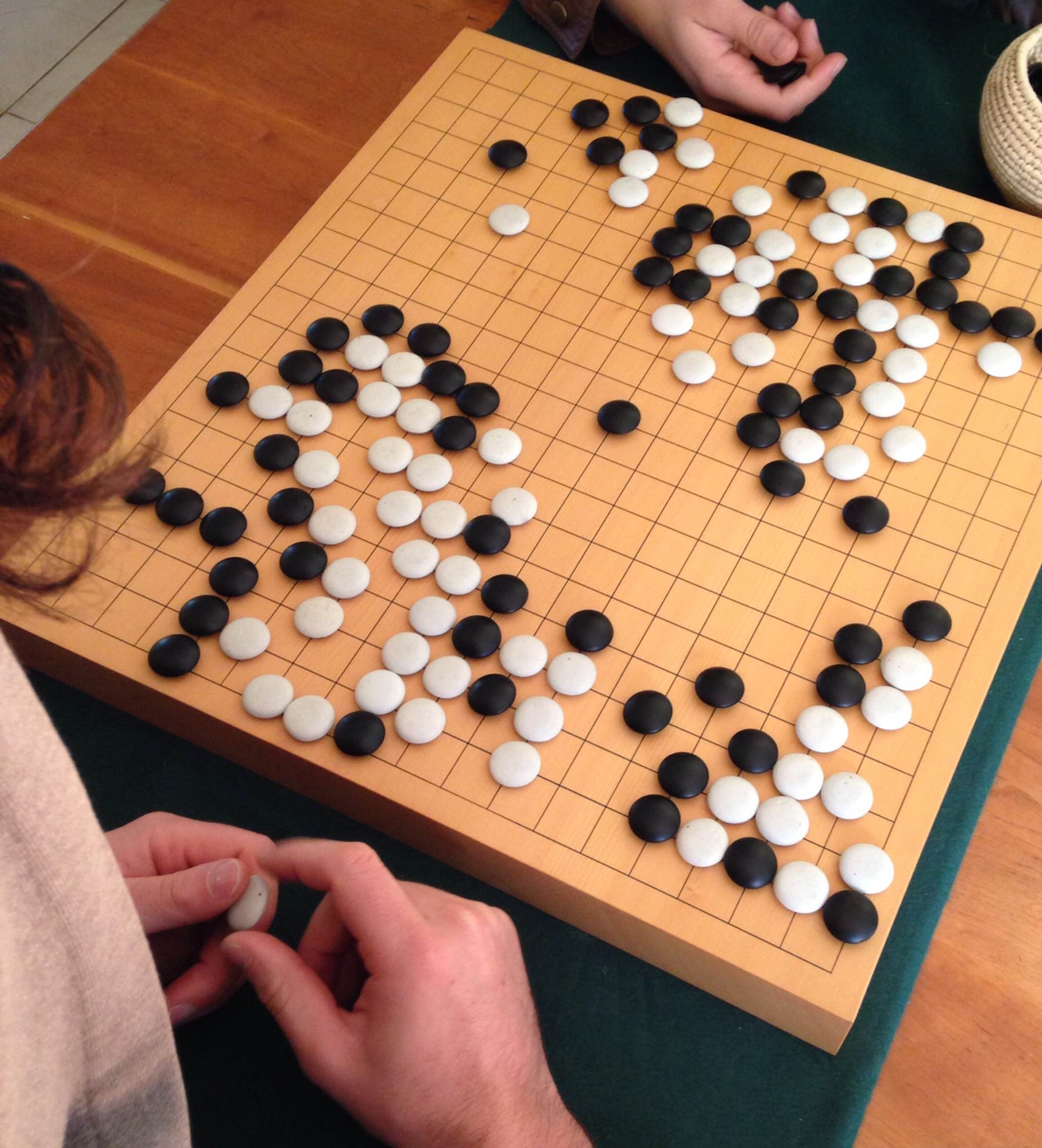
A gentleman (and many women) in traditional China would learn music, calligraphy, painting and the game of Go — in Chinese, “Wei Qi” or “surrounding chess.” Qín qí shü hùa were the four arts of the cultivated person, literally “zither, chess, writing and painting”. All of these arts introduce different facets of the same cosmic principles.
Let us take the most apparently trivial: the game of Go …

Art of Living and Weiqi
Click for complete article pdf (no charge, no sign-up, no nothing: just the article).

Go board

Ba Duan Jin on the bed

Eight Sections of Brocade is a traditional Daoist health maintenance program reputedly created by Zhongli Quan in the Tang dynasty more than 1000 years ago. Over that thousand years it has spread widely among the people, and has a variety of movements, some standing and some sitting. In the past two posts a common version of the standing movements was introduced, and here we will complete the routine with the sitting movements, which are actually a form of self-massage the Chinese call dry bathing.

If the room is warm enough, it is best to wear as little clothing as possible. One can sit in a chair or on the bed, or the floor if warm. Throughout the exercises the mind should remain (or be gently returned to) the area of the umbilicus, and one begins with three gentle deep breaths, then rub the hands vigorously together – especially the palms – for a full minute. Once the palms are warmed, the massage can begin.

Head, neck, eyes and nose
Rub the warm palms very gently over the skin of the face in circular motions, then use the fingertips to rub backwards through the hair at the sides of the head nine times, ending by rubbing the back of the neck and the area around Fengchi (GB-20) at the base of the skull with the fingertips. Use the sides of the thumbs to rub outward along the eyebrows from the point between them (Yintang) nine times, then the thumbs massage the temples (Taiyang) clockwise nine times, then counter-clockwise. Finally rub up and down alongside the nose, at the point Yingxiang (LI-20).

Teeth and tongue
Now, instead of the hands, use the tongue to massage the gums both inside and outside of the teeth, circling all over the mouth. The saliva that gathers should be held in the mouth for the space of a deep breath, return the mind to the umbilical area, and swallow the saliva. Very lightly chomp together the upper and lower teeth 18 times.

Sounding the Drum of Heaven
Rubbing the palms together again until warm, put the palms over the ears, with the fingers pointing backward. Place the index finger on top of the middle finger, then flick it downward to strike the skull, creating a deep drum-like sound, 36 times. After this rub fingers behind the ears up and down nine times, then rub the ears themselves.

Rubbing arms, shoulders, back and chest
Slide the palm forcefully up the inside of the arm, over the shoulder to the neck, and down the outside of the arm nine times, then repeat on the other arm. Rub the palms together until warm again and, with fingers pointing down, rub up and down the lower back until the area is warm and you have raised a light sweat doing so. Then massage the flanks and chest with circular motions.

Chafing the well of eternity
Roughly rub the legs all over, from top to bottom and back again, then place one foot on the knee and rub the point Yongquan (K-1) on the centre of the sole 81 times before shifting to the other foot and repeating. Rub lightly between the toes with the fingers once or twice.

Two palms warm the Cinnabar Field
This can be done sitting, standing or lying down. Placing one palm over the back of the other hand, gently rotate the hands over the lower abdomen 18 times, then reverse the direction and do it again. One should by this point feel an utterly delicious feeling of tingling relaxation throughout the whole body. Lying down to sleep, one can concentrate the qi that has been generated by lying on the back, and placing the hands over the spot on the body where the breath naturally reaches – for some this will be the chest, for others the upper abdomen, for some the lower abdomen. The sleep that follows this routine is extremely beneficial and refreshing, and long-term practice will demonstrate why Daoists were often called ‘Immortals’ – they never seemed to age!

IMG_8162

Two Letters of Liu Yiming

A letter in answer to General Su

Yesterday at the provincial capital  you honoured me with your elder presence and did not disdain the wilds of the mountains for our talk, and the [Daoist] mnemonic rhymes you passed on I have found very beneficial.

It is true when they say “when old friends meet, the warmth exceeds all class distinctions.”

When this patch-robed monk  was young, I had no discernment of what was deviant or correct. I would ask anyone and study anything, one day with Wang, another day with Li, a little bit of one thing then a little bit of something else.

Nothing came of this.

Then I met a Daoist who taught stillness techniques and …

Two Letters of Liu Yi Ming

(translated by Xiaoyao, these letters have, as far as we know, not been previously translated into English)

Only three sources of energy

People often ask why they are no longer as fertile as they were in their twenties. “I mean, I am only 35, its not like I’m old or anything. Why should I be less fertile than when I was 25, or even 20?”

In attempting to answer this question over the years, a diagram emerged (below) that illustrated the situation in financial terms. This seemed to be the most understandable for people. But just by the way it also illustrated the need for yang sheng practices: practices that nourish life, regular practices that reduce the leakage of jing, qi, and shen: vital essence, energy, and spirit.


Three Sources of Energy diagram
Air             from           Lungs
Income                                      Food and drink       from         Spleen

Inherited Trust Fund                 Inherited jing/essence         Kidneys


We have only three sources of energy: the air that we breath, the food that we eat, and the inherited jing/essence which is stored in the Kidneys. It is this last which supports our growth in our mother’s womb until we are born, and then continues to support the growth of the bones of our frame until we are more or less fully grown. This inherited jing/essence then turns into our own reproductive energy. Like a family trust fund passed down the generations, intended to be preserved and increased, the jing should be employed only for reproductive purposes or for emergencies, while we live day-to-day on our ‘income’: the air and food we take in.

But we don’t.

We, like little rich kids bedazzled with our wealth, spend beyond our income, and simply borrow from our trust fund whenever we need more energy  or simply want a ‘buzz’. This in fact is the tell-tale sign that we are borrowing from the Kidney jing: instead of the normal feeling of quietly sufficient energy, we get the fine tremor, the ‘rush’, and even occasionally palpitations and insomnia when we really overdo it.
Coffee and other stimulants do not give us energy, they simply facilitate a loan from the trust fund.
This trust fund is not bottomless, however, as much as it may seem so in our 20s: we begin to notice that our hair or skin is not so shiny or resilient, we don’t heal as well as before, and in fact, we are aging.

Shock.

It’s an even greater shock when (or more like ‘if’) we ever think through the consequences of the scenario:
a) We have never lived solely on our ‘income’, and b) We have been borrowing steadily from our trust fund, but c) This is now depleted, so d) We are forced to live on our income, but e) We still spend at the same rate.

No wonder things are breaking down! And they can only break down so far, before …

The Daoists, among others, very early on saw the way this scenario played out, and decided to take steps. Over the centuries they researched and developed a variety of methods for turning this process of depletion around, starting with reducing the loss of whatever jing/essence still remains, then starting to replace it.
Kidney jing/essence can be replaced, built up again, but it is a slow process because this energy is a reservoir of concentrated potential, whose main defining characteristic is accumulation in stillness, over a long period.

Unfortunately for us, stillness over any period of time is not a feature of Western society, and lest we be consumed in the fires of our own mad activity we desperately need to learn and practise these life nourishment techniques that the Daoists (and others) have developed and preserved for us, the later generations.

As the Daoists would say, if we can extend our lifespan we might have a chance of learning something worthwhile …

Review: Thomas Cleary’s Vitality, Energy and Spirit

Review:  Thomas Cleary’s

Vitality, Energy and Spirit

and

Taoist Meditation

When I first noticed Thomas Cleary’s wide range of translations from Buddhism, Daoism, Confucianism, and later Islam, I was dismissive: ‘Too many books,” I thought, vaguely, something along the lines of ‘jack of all trades, master of none.’ Furthermore, looking into these books, they did not have the detailed endnotes of the scholar, despite his PhD from Harvard: why this Chinese character was chosen for this sentence, instead of that; what other authorities thought and said.
“Shallow,” was my judgement.

After having it brought to my attention that such a judgement might be hasty, and over the intervening years having perhaps matured, to an extent, in my appreciation of some things, a revisiting of the Cleary books brought a very different conclusion. That conclusion, steadily reinforced with the passage of time, was that these translations are an accurate conveyance of the original practical intent of the texts he has chosen to translate; not simply translations of the words, but a conveyance of the heart of the text, the underlying meaning, done by someone who understands that meaning.

He recounts in the afterword to one of these books that this understanding came from

… my own introduction to the golden flower practice of “turning the light around,” long before I knew of the existence of this particular book [the Secret of the Golden Flower]. Finding this method of mindfulness extremely powerful and versatile, I subsequently spent many years studying its use in experience and looking for tested information pertaining to its objective application.

Cleary found that similar techniques of mindfulness played an important role in many if not all religions, although ‘dressed’, as it were, in very different costuming. Peeling away the packaging revealed a surprising identity of content within these religions, albeit expressed with characteristics determined by the culture: quiet, simple and practical for Chinese, for example, while the Indians might express the same core experience in colourful emotional ways.

In short, it seems to me there is a fair chance that Cleary knows what he is talking about, from experience. The texts are practical, that is, intended to be used. This is explicitly stated in his book Immortal Sisters: secret teachings of Taoist women:

The present volume addresses itself to individual pragmatic issues, and not to the sociology and politics of times gone by, for the simple reason that it is only by tackling practicalities on an individual level that the living element of Taoism can be brought out of past history and localized culture into the present reality of everyday life. This means seeking the essential rather than the incidental, the fundamentals rather than the outgrowths, that which applies to the human mind itself rather than to a specific mentality alone.

In other words, Cleary is of the opinion that it may be more valuable to learn to access the living flow which gives rise to Daoism and equivalent streams, a flow which is present now, rather than simply try to look like or act like a 12th century Daoist.

In the Taoist series, probably the best books to begin with are Vitality, Energy, Spirit: a Taoist Sourcebook, and Taoist Meditation. The former has selections spanning the whole history of Daoist thinking, in particular regarding Jing/essence (vitality), Qi (energy) and Shen (spirit), their appreciation, conservation, cultivation and ultimate unification.

In the much shorter Taoist Meditation, Cleary says:

Meditation is one element of Taoism that interests a broad spectrum of people, because the state of mind is central to the well-being and efficiency of the whole organism. Taoist meditation is for enhancement of both physical and mental health, as these two facets of well-being are intimately related to one another.

The practicality of these texts is shown in the clear directions provided for checking one’s own progress, and warning indications for when things are going wrong. An example is in this excerpt from the Tang dynasty Sima Chengzhen’s Treatise on Sitting Forgetting:

As long as the mind does not stick to things, and you can remain unmoved, this is the correct foundation for genuine stabilization. If you stabilize the mind by this means, your mood will become harmonious; the longer you do so, the lighter and fresher you feel. If you use this as a test, error and truth become evident.
If you extinguish the mind whenever it is aroused, without distinguishing right from wrong, then you will permanently cancel awareness and enter into blind trance.
If you just let your mind be aroused without collecting or controlling it at all, then you are after all no different from an ordinary mortal.

Then there are the “Sayings of Master Danyang”, from Ma Dan-Yang, whose “Song of the 12 Heavenly Star Points” is an acupuncture classic.

Here are two selections:

The energy in the body should not be scattered, the spirit in the mind should not be dimmed.
How do you avoid scattering energy?
By not acting compulsively.
How do you avoid dimming the spirit?
By not keeping things on your mind.

If people can master the path of purity and serenity, that is most excellent. Therefore scripture says, “If people can always be pure and serene, heaven and earth will resort to them.”
This ‘heaven and earth’ does not mean the external sky and ground. It refers to the heaven and earth in the body.
Above the solar plexus is called heaven, below the solar plexus is called earth. If the energy of heaven descends and the vessel of earth opens, so that there is harmony above and below, then vitality and energy spontaneously stabilize.