Tag Archives: Daoist

Huang Yuanji comments on Laozi Chapter Six (“The Valley Spirit Does not Die”)

(excerpt)

If people want to refine elixir to attain the Way of long life and eternal vision, there is no path without this mysterious female. Is this not the root of heaven and earth?

When practitioners lower their eyelids and turn the light around to become like Hundun– undifferentiated wholeness without knowledge–it causes the ordinary mind to die. Suddenly there is a feeling and a movement, activating unified awareness. 

This gives birth to the mind of the Way. This is what is meant by being the original spirit in stillness, and becoming true intent in action.

Once foetal breathing moves, do not keep intensely fixated on the Dan Tian. Be poised neither inside nor outside while observing its ascent and descent, coming and going. Relaxed and lively, you can then attain true foetal breathing.

Master Nan discusses a Daoist poem

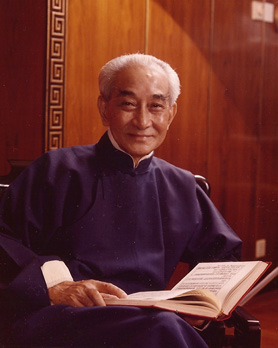
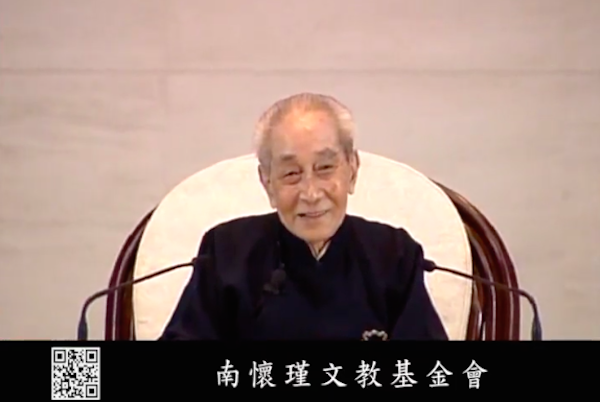
Nan Huaijin

Nan Huaijin (Nan Huai-Chin), who passed away not long ago, was a recognised vajra master in Buddhism, but was unusual in that he was also thoroughly schooled in Confucianism and Daoism.

This poem from Zhang Bo-Duan (author of the Wu Zhen Pian: Understanding Reality, one of the most famous classics of Daoist alchemy) was explained by Master Nan during a seven day Zen retreat held in China.

Mater Nan led into the discussion by comparing modern physical science and Buddhist sciences:

“Studying Buddhism is a science of life. It is different to natural science in that it does not use the physical things of the external world, but instead uses the functions of one’s own body, the five sense organs, and the biggest organ, that of the brain. But it is using the brain to turn around and investigate itself, the mind to turn around and look for one’s own mind within.

There is a Daoist, one of the patriarchs of the Southern school, Zhang Zi-Yang (Zhang Boduan). A Daoist, yet he was also thoroughly versed in Buddhism, especially Chan in which he was a high illuminate. This True Man, Zhang Ziyang, wrote a truly excellent poem about the experience of quiet sitting in Chan.

心内观心觅本心

xīn neì guān xīn mì běn xīn

Observe the mind within the mind to search for the root mind.

This is what we were just speaking about: turning around to look for one’s own mind; interior observation of one’s heart, the effects of our thoughts and feelings. This is mind, the function of heart/mind.

When I say “heart” I do not mean the physical heart, it refers to what we now call the brain, the feelings, knowledge, sensations … all these caught up together is what we are calling heart/mind, this basic function.

Before we were born of our father and mother, before we had become a foetus, did this mind exist? This is what we are looking for, not what Western philosophy talks about as mind. What Western philosophy means by ‘mind’ is what is known in Buddhism as the function of the sixth consciousness: the thinking mind, the thoughts in the mind, that is the sixth consciousness.

It is not mind as a whole.

We are talking about mind as a whole.

心内观心觅本心

xīn neì guān xīn mì běn xīn

Observe the mind within the mind to search for the root mind.

Where is that original mind? What is the origin of the origin? Without my brain, without my body, where after all is that heart/mind?

Here is the second sentence:

心心俱绝见真心

xīn xīn jù jué jiàn zhēn xīn

Cutting off thought after thought, you will see the true mind

All the thoughts and feelings inside you, all that is happening, all come to rest, all quiet and still. Slowly, slowly, they all cease; totally and absolutely still and quiet, all errant thoughts stopping. Feelings, knowledge, everything, all rests.

“Perceiving the true heart/mind” (见真心jiàn zhēn xīn) – you can then observe your own true and proper fundamental origin (真正根源 zhēn zhèng gēn yuán), the function of the root mind.
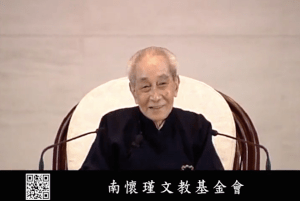
Nan Huaichin

The third sentence:

真心明徹通三界

Zhēn xīn míng chè tōng sān jiè

The true mind penetrates with clarity throughout the three realms 

If you can find the foundation of the root mind, the root essence (本性běn xìng), if you understand it, realise it, and truly verify it—not theoretically, mind you, but throwing your whole body and mind into this search to verify it—then one can transcend this material world, leap beyond the “three realms” (of desire, of form, and of formlessness). Hence “The true mind penetrates with clarity throughout the three realms. ” Then, he concludes:

外道邪魔不敢侵

waì daò xié mó bù gǎn qīn

Heretics and evil spirits dare not encroach.

Ghosts, devils, spirits, none of them dare to molest you. Zhang Zi-Yang was very well-known, an accomplished expert in both Buddhism and Daoism, in what they call the Southern School of Daoism. He was one of the patriarchs of this Southern School.


Observe the mind within the mind to search for the root mind.

Cutting off thought after thought, you will see the true mind.

The true mind penetrates with clarity throughout the three realms.

Heretic and evil spirits dare not encroach.

Again, Farewell — a Tang poem by Yu Xuanji

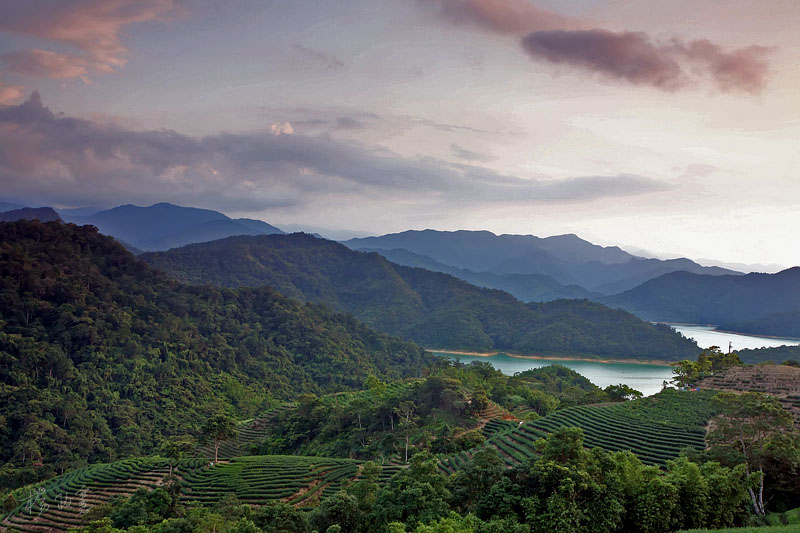
moutains in Taiwan copy

水柔逐器知難定,

雲出無心肯再歸。

惆悵春風楚江暮,

鴛鴦一隻失羣飛。


Water, being soft, seeks holding; 

But knows it won’t last.

Clouds disperse, and lack heart to return.


The spring day is over now, for this river; 

And the rueful wind goads

A widowed duck, lost amidst the sky.


This is the second poem that Yu Xuan-Ji entitled ‘Farewell,’ the first was published in the previous post, where the motif of dispersing clouds also appeared.

This subsequent poem is less intensely personal, and more abstract and philosophical: Yu writing about the same relationship perhaps after the passage of time. ‘Water seeking a vessel’ is a very Daoist image, as the Dao will flow into any receptive container; but the flow of attraction is very similar, and similarly impermanent—unless there is a heart. The clouds which disperse in both poems show Yu’s perception that ‘a lover’ is not just a body, but a total ambient presence of ideas and feelings and fragrances and visuals and more; unless ‘clouds’ can coalesce around a ‘heart’, they must disperse, with no return.

At the ‘turn’ of the poem, where the images change, we get the feeling that Yu is the river here, flowing within the banks of herself; the word chŭ 楚 (translated here as ‘goad’) is usually left out of translations of this poem, as the modern definitions do not seem to fit. But in ancient Chinese 楚 meant ‘thistles’ or ‘a handful of thistles used as a whip’. So while in the first poem her ‘wild moth’ of desire still fluttered dangerously around the lamp of love, even as that lamp faded and failed, here the full painful effect of these feelings torture her, she who is also the lone duck, the bereaved survivor of a pair of mandarin ducks, who in legend mate for life. The spring wind, by the way, is that which breaks up ice, dissolving connections.

(translation and comments by Steve Clavey)

Of insight, wholeness and understanding

There is a commonly used phrase in Chinese: 物极必反  wù jí bì fân – when things reach an extreme they turn and change. The phrase can be used as a warning, or a message of hope, but in the final analysis it is descriptive; it describes an observable process of nature, the cycle. Things can only go so far before a change has to occur.
Most traditional cultures recognise this as a core fact, but our modern Western culture, in the pride of its growing dominance around the world, acts like an arrogant adolescent. “There are no consequences!” all its actions shout.

“There are no consequences!”
.

However – the end of the world aside – this process of a cycle also applies in methods and styles of investigation, of learning about the world, of epistemology. More and more our preferred method of gaining knowledge relies upon technology, machines that extend our senses outward, that increase the raw calculating power of our brains, that manipulate things so tiny we could never perceive them without these extensions of our eyes, ears and fingers.
And this manipulation of the external world is fascinating (and profitable, don’t forget the profit), so fascinating that we forget that there are other ways of knowing.

These other ways are more personal, and do involve technology, yet these techniques are not external but internal to the person employing them. They too extend the senses, but not outward; this technology refines the inward sensing of movements and processes that are just as much a part of the world as the hydrologic cycle of rain or the movement of the planets, but they are known directly within the observer.
One interesting thing is that up until very recently, historically speaking, these two epistemological methods were not considered mutually exclusive. Goethe in the West is an excellent example of the combined use of both methods.1

Among others the Taoists in China were serious investigators of all realms, inner and outer. The early chapters of the Lei Jing suggest that the most talented of Chinese physicians may have accessed Taoist technology to enhance their understanding of the inner processes of the body, and thus take their medical abilities to new heights.
The other interesting thing is that the cycle that has afforded an absolute preference to the artificial “high-tech” sensory extensions may be close to its peak, and a change about to occur. One of the problems with the outward focused investigation is its tendency to proliferate detail in ever diffuse complexity, with difficulty apprehending the unifying factor, the central organising idea, its “wholeness”. This gives the process a sensation of cold lifelessness that patients (and the investigators themselves!) sense. It is also expensive, and for all its precision often quite slow: someone needing treatment right now might have to wait many days for “the tests to come back”.

One of the problems with the outward focused investigation is its tendency to proliferate detail in ever diffuse complexity. This creates difficulty apprehending the unifying factor, the central organising idea, its “wholeness”.

It may be time for the other method of epistemology to reappear and begin to restore the balance. This method is characterised by its apprehension of the linking of relationships, its unity, and this recognition of linking relationship often occurs in a flash of insight that not only knows what the problem is, but also how to rectify it.
I believe it is the place of Chinese medicine to offer access to this type of knowing, which will complement and balance (certainly not replace) those of artificial machine technology; that practitioners should have available training in the embodiment of the technologies that foster the flash of insight, the sense of wholeness, the understanding of relationships (medical, psychological and social). After all, the best of our predecessors seem to have been doing just that for centuries. Furthermore, since there is little doubt that our medicine has been shaped by the technology discussed above, its practice quite naturally urges the employment of those techniques for its complete expression.

A friend of mine with whom I used to discuss these things gave me a simple but classic example of how insight might work in clinic. A patient, he said, came to visit him and reported that her GP could not explain why her iron stores (ferritin levels) were low, while her haemoglobin was normal. Without any thought, he said, a possible explanation immediately occurred to him. “How are your stress levels?” he asked. When she reported extremely high stress levels, my friend explained that a probable explanation was the mobilisation of the blood stores to provide the ample supply that may be needed in a “fight or flight” situation. He was able to then use this hypothesis to guide his treatment.
Insight, the deep apprehension of how a system acts as a whole, the recognition of non-obvious linkages — these need not be the province of only a talented few, as techniques for training these skills exist and have been utilised for centuries. It is perhaps no coincidence that these techniques are also much more readily accessible now than they have been in the past, and this may be because we desperately need them.

What I mean is that even a modicum of experience with allowing the mind to settle and clarify itself will open up access to some of our quite natural and everyday abilities that are presently obscured by the continual distraction surrounding us. We don’t have to become “enlightened”, we just would benefit from becoming a bit more aware of the rich textures of life around and within us. And our patients would benefit, too.

Endnote
1. See Henri Bortoft, The Wholeness of Nature: Goethe’s Way Toward a Science of Conscious Participation in Nature, Lindisfarne books, 1996. Henri Bortoft has taught  physics and philosophy of science. He did post-graduate work with David Bohm and Basil Hiley on the question of wholeness and quantum  theory. About Goethe:

“It was Goethe’s belief that we should study nature and our world as people who are at home here, rather than as separate and alien from our own environment. He adopted a qualitative approach to science—one at odds with the quantitative methods of Newton, which were equally popular in his day. His is a sensitive science that includes our interrelationship with nature. Today, his ideas have been given special attention by scientists such as Adolf Portmann and Werner Heisenberg.”

Two Letters of Liu Yiming

A letter in answer to General Su

Yesterday at the provincial capital  you honoured me with your elder presence and did not disdain the wilds of the mountains for our talk, and the [Daoist] mnemonic rhymes you passed on I have found very beneficial.

It is true when they say “when old friends meet, the warmth exceeds all class distinctions.”

When this patch-robed monk  was young, I had no discernment of what was deviant or correct. I would ask anyone and study anything, one day with Wang, another day with Li, a little bit of one thing then a little bit of something else.

Nothing came of this.

Then I met a Daoist who taught stillness techniques and …

Two Letters of Liu Yi Ming

(translated by Xiaoyao, these letters have, as far as we know, not been previously translated into English)