Tag Archives: Taoism

Huang Yuanji comments on Laozi Chapter Six (“The Valley Spirit Does not Die”)

(excerpt)

If people want to refine elixir to attain the Way of long life and eternal vision, there is no path without this mysterious female. Is this not the root of heaven and earth?

When practitioners lower their eyelids and turn the light around to become like Hundun– undifferentiated wholeness without knowledge–it causes the ordinary mind to die. Suddenly there is a feeling and a movement, activating unified awareness. 

This gives birth to the mind of the Way. This is what is meant by being the original spirit in stillness, and becoming true intent in action.

Once foetal breathing moves, do not keep intensely fixated on the Dan Tian. Be poised neither inside nor outside while observing its ascent and descent, coming and going. Relaxed and lively, you can then attain true foetal breathing.

Li Dao-Chun explains the word Dào

Dào  道

By Li Dao-Chun


The Dao that can be talked about is not the true enduring Dao. The true enduring Dao begins where there is no beginning and is named from that which has no name. Thinking to discuss it, you feel like you have it straight in your mind, but as soon as you open your mouth you are wrong.

Suppose you could speak: what is the Dao? Since one cannot speak, how is one to perceive the Dao? What you can say is not right, not speaking is also not right: so what is right?

If you can apply a turning phrase right here at this point, all of your studies are complete.¹

But if you cannot, you will need to check, 24 hours a day, rising, resting and eating, all those places you turn your mind to: what is this majestic, lively, nothing-to-do-with-the-world thing? Checking this, checking that, checking until there is no longer any place to check, suddenly you feel the breath in your nostrils and break out in a sweat all over, and only then do you know that this was something you had yourself all along, something which has not changed during the last age of the world, and that is why they say not for an instant can one separate from the Dao.

They also say walking, stopping, sitting or lying down, this cannot be left; moreover between heaven and earth every thing, animate or inanimate, all are this; from ancient times to the present it is only this; what gave birth to heaven and gave birth to earth is only this; as to everyday common use, every breath, moving or still, is yet only this.

Every single thing that has form will decay, only this is ever present. Heaven, earth and space all come to ruin, only this will never degenerate.² If only this cannot be penetrated with iron eyes and bronze pupils, why can it not be penetrated? The problem lies in not coming face to face with it, although coming face to face with it is also a mistake – but you must say where the mistake is!

Do not just answer randomly! How does it all actually and finally come together?

I explain and make this all clear, but there is a lack of people willing to take it up.

If only I could encounter someone who knew my heart, I’d give them a wink and pick them up, hey?

   Last night, a new rain passed the head of the river.

   This morning, as of old, the distant mountains are green.


Ode

Reaching the limits of the Dao, most empty and quiet

Formless, shapeless, nameless and immaterial

Unseeable, ungraspable, imperceptible: seek it, it’s untraceable

Uncontained by the greatest, entering even the tiniest

Generates heaven and earth, nourishes the ten thousand things

Transforming endlessly, hiding and emerging immeasurably

It cannot be known; knowing, it cannot be conceptualised

The tongue of the great Lao Zi had no bone, the classic clearly revealing it

Endless words are not worth a single silence

This Ο is a stop – then even more doubt than before!


Endnotes

1. “一转语 Yī zhuǎn yǔ is a Chan term for a word or phrase that reveals the speaker’s degree of enlightenment or that transforms the listener’s mind at a critical psychological moment.” Sasaki and Kirchner. The Record of Linji, University of Hawaii Press, 2009, p. 290.

2. Quran, Surah Al-Qasas, 28:88: “All things are perishing except for His face.”


Ma Danyang’s teacher leaves a poem

IMG_8174師言:祖師嘗到登州時,頂笠懸鶉 ,執一節、攜一鐵觀,狀貌奇古,乞於市肆,登州人皆不識。夜歸觀,書一絕於壁:
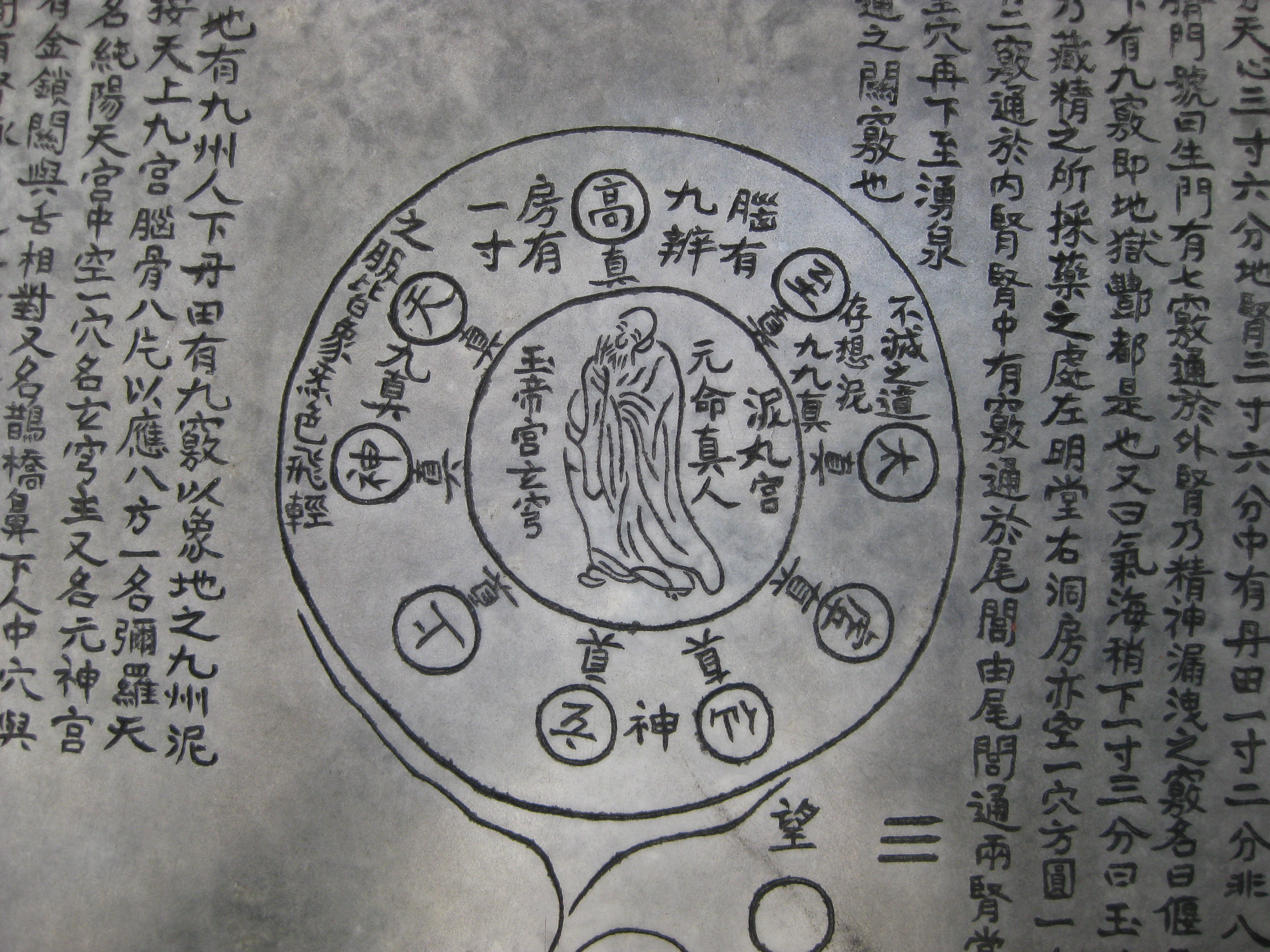
一別終南水竹村,
家無兄女亦無孫。
數千里外尋知友,
引入長生不死門。

明旦拂衣束邁。後數日,郡守紇石烈邈詣觀,觀其題詩,欽歎不已。乃依韻和曰:

迴首三年別故村,
都忘庭竹長兒孫。
他時拂袖尋君去,
應許安閑一叩門。

Our teacher Ma Danyang told us:

The founding teacher Wang Chongyang once went to Dengzhou¹ wearing a large bamboo hat and a patched cloak, with a bamboo staff in one hand and an iron bowl in the other. He looked like something from an old legend. He went begging in the market, and no one in Dengzhou recognized him. In the evening he returned to the monastery and wrote a poem on the wall:

I left at last
The mountains of Zhongnan²
And my village of bamboo and water
Where no family remained —
Not brother nor daughter —

To search everywhere
For a knowing friend
That I may lead him
Or her³ to the gate
Of long life without death.

The next morning he shook out his sleeves and strode away.

A few days later, the local magistrate He Shilie arrived at the monastery from afar and saw the poem on the wall. He sighed, lost in admiration. Then he composed a matching poem, keeping to the same rhyme scheme:

You look back three years
When you left your hamlet
And your house, its courtyard
of bamboo, leaving your sons
and their sons.
But a time will come when I, too
Shaking out my sleeves, will search for you.
And will you, then, give leave for me
To cast off cares and knock at your gate?

from the Discourses of Ma Danyang

  1. On the coast of Shandong.
  2. As well as the place where Wang Chongyang founded the Complete Perfection school of Daoism, the Zhongnan mountains were the location of Louguantai  (楼观台), where Laozi traditionally was held to have transmitted the Dao De Jing to Yin Xi.
  3. This is not just modern political correctness. One of Wang Chongyang’s most famous disciples was Sun Bu-er–Sun the Inimitable–who was, as it happens, the wife of Ma Danyang.

Learning Sword Technique from the Adept Huo Long

“Learning Sword Technique from the Adept Huo Long”

Lü Yan, Complete Tang Poems

《得火龍真人劍法》    呂岩

昔年曾遇火龍君,一劍相傳伴此身。天地山河從結沫,星辰日月任停輪。

須知本性綿多劫,空向人間曆萬春。昨夜鐘離傳一語,六天宮殿欲成塵。

Long ago, meeting the Noble Fire Dragon,

He passed on a sword, my constant companion.

With it, heaven, earth, water and stone evanesce and dissolve;

Sun, moon, stars and planets cease to move.

Recognize that essence is stolen continuously. 

Be empty towards the world of men,

And each day will be a springtime.

But last night, Zhongli passed on this saying

And all the palaces of all the worlds

Fell to dust.


Lü Yan (,呂岩, 798 – ?, commonly known as Lü Dong-Bin吕洞宾, or Ancestor Lü 呂祖) was a Daoist patriarch in the late Tang dynasty. He was variously known as the “sword immortal”, the “drunken immortal” and the “poet immortal”. Indeed, some 200 of his poems are collected in the Complete Tang Poetry (Quan Tang Shi), and this is one of them, describing his legendary sword.

He learned the art of internal alchemy from Zhongli Quan, and according to the Song Shi (a history of the Song dynasty), Lü lived well past 100 years of age, with the complexion of a child and a light agile step. This was long enough for legends about him to spread widely even during his lifetime. He laughed about one story, and said “People say I have a flying sword to kill people. I can only answer by saying that [everyone knows that] those with compassion are Buddhas. But Daoist immortals are like Buddha too; how could we have swords to take human life? I do have a sword, but it is different to the usual: first it cuts off greed, then it cuts off desire, and finally it cuts off all mental disturbance. That is my triple sword-play.”

Do not extinguish the shining mind

Working diligently day and night, never wavering for a second, just extinguish the stirring mind, do not extinguish the shining mind; just stabilize the open mind, do not stabilize the dwelling mind. Do not rest on anything, yet have the mind always present.

Zhang San Feng (Chang San Feng),

Cleary Vitality, Energy, Spirit p. 201

Zhū Yuányù (朱元育) comments on a verse of the Wù Zhēn Piàn

The words of the myriad books on immortality are all the same – the golden elixir alone is the root source.

The substance is produced on the ground of the position of EARTH planted in the chamber of intercourse in the house of HEAVEN,

Do not think it strange that the celestial working has been leaked – it is because students are confused and ignorant.

(Understanding Reality, Cleary translation, p. 54)

This verse talks of the great way of the golden elixir, of transcending the common and entering the path of the sages. It is the final verse in the initial sequence of the Wù Zhēn Piàn.

The previous verses spoke of how the effect of the golden elixir was vastly superior to that of the side tracks, and how one could see that only this matter is factual, no other way was real. But it is not only this book, the Wù Zhēn Piàn, that states this: each of the ten thousand classics of elixir are concerned only with this single matter.

The pre-heaven Yì Jīng of Fúxī brings up Qián, Kun, Kăn and ; he was the elder pioneer who cleared the mountain for this temple of elixir classics. The Dào Dé Jīng and Qīng Jìng classics solely model themselves on Being-as-is. Although they directly point to the path of wúwéi, the effect of the golden elixir is already there within.

The books of Yīn Fù and Cān Tóng want people to return to their root, and although they detail practices that are yŏuwéi (ie, active as opposed to wúwéi), yet the effect in the final analysis still comes back to the great way of Being-as-is.

And everything that Zhuāngzi and Lièzi and the Wénshì Jīng expounded comes back to this, and what Zhōnglĭ Quán and Master Sea Toad described—all are just this: investigating the root of Essence and Life in order to set up the principle of the golden elixir. And as for the saying “only the golden elixir is worthwhile,” this is the root source.

The effect of the golden elixir is explained in detail within the text, but the gist of it is merely to produce medicine in the furnace of Kūn (坤爐) and congeal the fetus in the cauldron of Qián (乾鼎). These two phrases cover it all.

In terms of the golden elixir, the great medicine is produced when Kăn and start to interact—this is the work in the palace of Kūn. As to culling according to the time, ascending to the entrance of the Celestial Valley, and guiding the return to the Yellow Court, these are all in the household of Qián.

In terms of elixir reversion (还丹), it is using a gentle fire to warm and nourish the medicine that has been gathered into the furnace; again, work in the palace of Kūn. As to the practice of concentrating fire and metal in close interaction at the peak of Kūnlún, this too is in the household of Qián.

When Master Cui said the birth is from Kūn, the seed is from Qián he was referring to all the above. This is why the line in the text here says The substance is produced on the ground of the position of EARTH (Kūn) planted in the chamber of intercourse in the house of HEAVEN (Qián).

Exposing things to this extent, Master Zhāng could be said to have openly revealed the secret Celestial mechanism. Yet worldly people still are misled by side-tracks! They might take, for example, ‘you’ and ‘I’ as Qián and Kūn, a mistake which destines  them for the lowest reach of hell. Or they might take ‘above the navel’ and ‘below the vertex’ in the body as Qián and Kūn, thus working their way toward the ghost cave at Black Mountain (黑山鬼窟). Isn’t this the ultimate stupidity?

The Twin Palaces of China

Chinese medicine is a treasure house, Mao told us, and so it has proven. For those of us in the profession it provides, at the least, a means of making a reasonable living in a satisfying and ethical way. But the more one engages with it, the more Chinese medicine reveals itself as a truly vast storehouse of treasures, each separate room an inexhaustible cornucopia of ways to improve the quality of living for oneself and others.

A separate room may be a specialty within the formal medical structure, such as paediatrics or ophthalmology, or it may be an area of investigation, such as herb growing and harvesting. Some rooms are larger than others. A small but very popular room is accessed by the billions who utilise some aspect of Chinese food therapy. We in the West have just barely peeked around the edge of the door in some rooms: an example of this is the meteorological–medical theory wuyun liuqi.

Indeed, we may find that exploration of this vast storehouse transforms us as we go, makes demands upon us that alter the way we experience ourselves and the world, challenges and changes our assumptions about how we as humans function, why we are, and even the boundaries of our skin.

One of the major halls in this storehouse is the experiential knowledge of the flow of qi around the body, both within and without the channels. We could almost call it the Hall of Qi, as it is an area that has led to the development of acupuncture, shiatsu, and qi gong, not to mention most of the Chinese martial arts. Involvement with qi gong or the martial arts (especially those known as “internal’” that put a premium on the development of proprioceptive awareness) will after a period of time — generally five years or so — find one developing an awareness of the circulation of qi, one that is not imagined or forced, but rather quite natural.

An older acupuncture teacher in China, who had also practised tai chi for a number of years, was incredulous when her new foreign students kept asking questions like: but how do you know the acupuncture points and channels are here, in this spot, and not somewhere else? She finally said, exasperated: “But can’t you feel it?”

It starts to look as though we, the modern sophisticates, are the ones who lack refinement in this area. Is it possible that there are ways of feeling and sensing that are simply not developed in our culture, while being so commonplace in other cultures that they are taken for granted?

As we get better at this, we may find that Chinese medicine students can learn in the body, instead of just in the head; that qi gong or tai chi or other internal martial arts will be core subjects taught by experts, rather than electives. At the moment, we should certainly be increasing the awareness of the part that yang sheng (life nourishing) exercises can play, not only in keeping practitioners healthy, but in fostering a deeper, more palpably experiential understanding of their art.

It is easy to wander from that Hall of Qi into an adjoining palace called Daoism (which Mao, strangely enough, never mentioned) — the two buildings share a non–existent wall.

While Chinese medicine has informed Daoism from the earliest times, the influence flowed strongly both ways. Many of the best known early authors in our medicine were as well–known for their Daoist works as for their medical texts, and these include such heavyweights as Ge Hong (Zhou Hou Bei Ji Fang), Tao Hongjing (Ming Yi Bie Lu, Ben Cao Jing Ji Zhu), Sun Simiao (Qian Jin Yao Fang), Meng Shen (Shi Liao Ben Cao) and even the famed Tang dynasty commentator on the Huang Di Nei Jing, Wang Bing, whose standard version we still use today.

All of these authors have works discussing the practice of Daoism. This pattern continues throughout the history of TCM: Ma Danyang (to name a single further example) is the compiler of the Ma Danyang’s 12 Heavenly Star Points of Acupuncture song (Ma Danyang Tian Xing Shi Er Xue Ge) but he is even better known as one of the seven illustrious disciples of Wang Chongyang, along with his famous wife Sun Buer — Sun the Inimitable.

The point of this retro romp is to flag this connection between Chinese medicine and Daoism, for the few who may not be aware of it, and to perhaps pique the curiosity — why is the connection so strong? Did the Daoists, those early scientists, discover in their investigations not only better herbal medicines and more effective uses of points, but other things that improved their medicine?
Those interested in delving deeper should read the book review section, where several of Thomas Cleary’s books on Daoism were introduced.

Ba Duan Jin on the bed

Eight Sections of Brocade is a traditional Daoist health maintenance program reputedly created by Zhongli Quan in the Tang dynasty more than 1000 years ago. Over that thousand years it has spread widely among the people, and has a variety of movements, some standing and some sitting. In the past two posts a common version of the standing movements was introduced, and here we will complete the routine with the sitting movements, which are actually a form of self-massage the Chinese call dry bathing.

If the room is warm enough, it is best to wear as little clothing as possible. One can sit in a chair or on the bed, or the floor if warm. Throughout the exercises the mind should remain (or be gently returned to) the area of the umbilicus, and one begins with three gentle deep breaths, then rub the hands vigorously together – especially the palms – for a full minute. Once the palms are warmed, the massage can begin.

Head, neck, eyes and nose
Rub the warm palms very gently over the skin of the face in circular motions, then use the fingertips to rub backwards through the hair at the sides of the head nine times, ending by rubbing the back of the neck and the area around Fengchi (GB-20) at the base of the skull with the fingertips. Use the sides of the thumbs to rub outward along the eyebrows from the point between them (Yintang) nine times, then the thumbs massage the temples (Taiyang) clockwise nine times, then counter-clockwise. Finally rub up and down alongside the nose, at the point Yingxiang (LI-20).

Teeth and tongue
Now, instead of the hands, use the tongue to massage the gums both inside and outside of the teeth, circling all over the mouth. The saliva that gathers should be held in the mouth for the space of a deep breath, return the mind to the umbilical area, and swallow the saliva. Very lightly chomp together the upper and lower teeth 18 times.

Sounding the Drum of Heaven
Rubbing the palms together again until warm, put the palms over the ears, with the fingers pointing backward. Place the index finger on top of the middle finger, then flick it downward to strike the skull, creating a deep drum-like sound, 36 times. After this rub fingers behind the ears up and down nine times, then rub the ears themselves.

Rubbing arms, shoulders, back and chest
Slide the palm forcefully up the inside of the arm, over the shoulder to the neck, and down the outside of the arm nine times, then repeat on the other arm. Rub the palms together until warm again and, with fingers pointing down, rub up and down the lower back until the area is warm and you have raised a light sweat doing so. Then massage the flanks and chest with circular motions.

Chafing the well of eternity
Roughly rub the legs all over, from top to bottom and back again, then place one foot on the knee and rub the point Yongquan (K-1) on the centre of the sole 81 times before shifting to the other foot and repeating. Rub lightly between the toes with the fingers once or twice.

Two palms warm the Cinnabar Field
This can be done sitting, standing or lying down. Placing one palm over the back of the other hand, gently rotate the hands over the lower abdomen 18 times, then reverse the direction and do it again. One should by this point feel an utterly delicious feeling of tingling relaxation throughout the whole body. Lying down to sleep, one can concentrate the qi that has been generated by lying on the back, and placing the hands over the spot on the body where the breath naturally reaches – for some this will be the chest, for others the upper abdomen, for some the lower abdomen. The sleep that follows this routine is extremely beneficial and refreshing, and long-term practice will demonstrate why Daoists were often called ‘Immortals’ – they never seemed to age!

IMG_8162

Fragrant shower

Several readers have taken me to task for, they said, being too negative. Surely health is not just about avoidance? Surely what we do is more important than what we don’t do?
I can understand  their point  of view: doing exercises to nourish  life is far more interesting than stopping up the leaks, as crucial as this is. It does put me in mind, though, of an old story told in the far west of China, in Chinese Turkestan, a tale of Afanti — the Effendi — who was either extremely wise or extremely foolish; no one could tell which.

It seems that one day Afanti was standing at the pump in the public square, pumping water into a pitcher in his hand. This went on for some time, until one of the gathering onlookers said to him: “Afanti! You will never fill that pitcher, for it has no bottom!” Afanti looked at him indignantly and said, “I am not interested in the bottom of the pitcher, I want to fill it to the top, and so I am looking at the top. Don’t distract me with irrelevancies about the bottom!”

Now that I have had my say, however, a useful technique is described in a number of traditions such as the Daoist and the Zen streams, and probably others of which I am unaware. The aim is to systematically melt away tensions in the body and mind.

The technique
Sit in a comfortable position. Standing is also possible, but is best done in the posture used at the beginning of a Tai Chi set, before any movement takes place. If you do not know what this means, better sit. Once practised with the technique, it can be done in any posture.
Now visualise a slow stream of comfortably warm and fragrant sesame oil flowing very slowly and gently down from the top of your head, dissolving any point of tension it may encounter. At first the warm fragrant liquid slowly covers every part of your head and face, melting away the tensions in your forehead, nose, eyes, ears and jaw, dissolving knots at the base of your skull and in your neck, and then pouring warmly down over your shoulders and back and chest, melting and dissolving as it goes. Its fragrant warmth then gathers briefly in the pelvis and hips before moving on into the buttocks, thighs and knees, down through the shins and calves, into the feet, where it pours into the ground.1

There are two important  points: one is that you begin to gently dissolve from the surface of the body, and over time extend this into the interior so that the organs are washed with the gentle warm fragrance of the melting sesame oil. The second is that throughout the exercise you maintain a gently straightened back and do not slouch, so that while everything is melting and pouring downward, there is still an upright centre (this is particularly important if one has low blood pressure). The effect is very much like the Tai Chi ideal: utter relaxation and flexible movement around an upright but not rigid centre.

This is an excellent prelude to a period of meditation or Tai Chi, but balance is the key: no exercise should be overindulged. It has been said that a technique like this, which is very “opening”, is best done when and where the surrounding environment is natural, supportive and beneficial, in order to absorb only the best influences. Similarly, it should not be done just prior to sleeping, but an interval allowed for the everyday self to regroup its usual — but much more relaxed! — self-image.
Another outstanding aspect of Daoist yang sheng exercise is the slow, gentle and deliberate stretching of all the major tendons in the body. Important  at any age, it becomes crucial as one gets older, as tendons stiffen and lead to imbalance throughout the structure of the body. Mindful breathing is often coupled with the slow and gentle stretching, which further relaxes the body in depth.

An excellent series of exercises for achieving this will be described in the following post about Ba Duan Jin.

Endnote

1. More on this technique can be found in the following two books: a detailed technical description in B. K. Frantzis’ Opening the Energy Gates of The Body (North Atlantic Press, 1993) and a more personal and warmer description in Wild Ivy: the spiritual autobiography of Zen Master Hakuin by Norman Waddell (Shambala, 2001).

Two Letters of Liu Yiming

A letter in answer to General Su

Yesterday at the provincial capital  you honoured me with your elder presence and did not disdain the wilds of the mountains for our talk, and the [Daoist] mnemonic rhymes you passed on I have found very beneficial.

It is true when they say “when old friends meet, the warmth exceeds all class distinctions.”

When this patch-robed monk  was young, I had no discernment of what was deviant or correct. I would ask anyone and study anything, one day with Wang, another day with Li, a little bit of one thing then a little bit of something else.

Nothing came of this.

Then I met a Daoist who taught stillness techniques and …

Two Letters of Liu Yi Ming

(translated by Xiaoyao, these letters have, as far as we know, not been previously translated into English)